

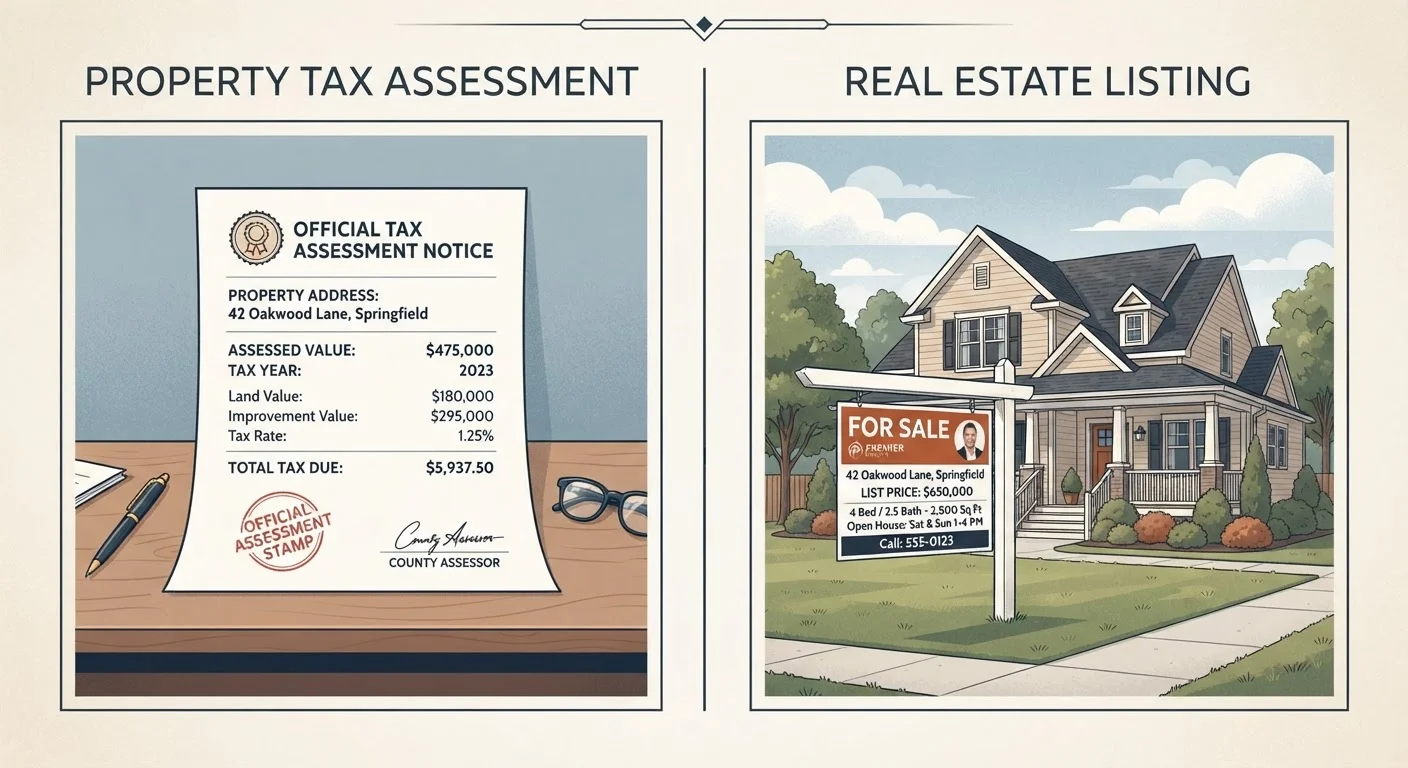
Two Numbers, Two Purposes
When you own a home, you'll encounter at least two distinct valuations that can differ by tens - or even hundreds - of thousands of dollars. That gap isn't a mistake or a conspiracy. It reflects the fact that assessed value and market value are tools built to answer entirely different questions.
Market value answers: What would this home sell for today? It's an estimate of what a reasonable, informed buyer would pay a willing seller in an open, competitive market. Real estate agents, appraisers, and lenders all work from some version of this figure when pricing a home, underwriting a mortgage, or negotiating a deal.
Assessed value answers: How much of the local tax base should this property carry? It's a figure assigned by a government assessor - typically at the county or municipal level - and it feeds directly into your annual property tax calculation. To understand how that calculation works end-to-end, see how assessed value, mill rates, and exemptions combine.
| Criterion | Assessed Value | Market Value |
|---|---|---|
| Set by | Local government assessor | Buyers, sellers, and market conditions |
| Primary purpose | Calculating property taxes | Pricing, lending, and equity decisions |
| How often it updates | On a fixed reassessment schedule | Continuously as market shifts |
| Relationship to sale price | Often a fraction of sale price | Closely tracks actual sale prices |
| Can you dispute it? | Yes, through a formal appeal | Negotiated between parties, not appealed |
| Relevant to mortgage lending? | Rarely | Central - lenders underwrite to this |
Why the Numbers Often Look Nothing Alike
Assessors rarely attempt to capture true market value. Instead, most jurisdictions apply an assessment ratio - a locally set percentage of market value - to arrive at the taxable figure. If your jurisdiction uses an 80% assessment ratio and your home's market value is $400,000, your assessed value might be set at $320,000. Some areas assess at 50% or lower.
Beyond ratios, reassessment schedules create additional drift. Many counties reassess properties only every one, three, or five years. In fast-moving markets, a home's market value can climb substantially between cycles while its assessed value stays flat. Some states also cap annual assessment increases - meaning long-term owners may carry assessed values well below what their property would fetch on the open market.
Assessment Ratios Vary Widely by State
There is no national standard for assessment ratios. Some jurisdictions assess at 100% of estimated market value; others assess at 50% or less. Your property tax notice or county assessor's website should disclose the ratio used in your area. When comparing tax burdens across states or counties, always factor in the ratio alongside the nominal tax rate - a low rate applied to a high assessment ratio can produce a higher bill than it appears.
This divergence works both ways. In declining markets, an assessed value set during a peak year can temporarily exceed what the home would realistically sell for - a situation that may give homeowners grounds to appeal. See how the assessment appeal process typically works if you think your figure is off.
What Each Value Means for Your Financial Picture
For most homeowners, assessed value primarily matters in one context: the tax bill. Because it's a government-calculated figure applied consistently across properties in a jurisdiction, it has little bearing on what a buyer will offer or what a lender will finance. If you're selling, refinancing, or simply tracking your equity, focus on market value instead - ideally through a professional appraisal or a comparative market analysis from a licensed agent. Understanding what appraisers actually weigh can help you interpret those figures more accurately.
That said, assessed value isn't irrelevant to your financial planning. Property taxes are a recurring, non-optional ownership cost. Property taxes combine with insurance, maintenance, and utilities to form the real annual cost of ownership - a picture that's easy to underestimate, especially for first-time buyers. And as new owners often discover, reassessment can be triggered by a sale, triggering a tax increase that catches unprepared buyers off guard.
~1.1%
Median effective property tax rate in the U.S.
According to the Tax Foundation, the national median effective property tax rate on owner-occupied housing is approximately 1.1%, though rates vary significantly by state and locality.
60-80%
Common assessment ratio range across U.S. jurisdictions
Many U.S. counties assess residential property at 60-80% of estimated market value, though some jurisdictions assess at significantly lower ratios.
The practical takeaway: track both numbers, understand what each one drives, and don't conflate them when making financial decisions.