

Why Low-Impact Movement Matters
Living with joint pain or limited mobility can make the idea of exercise feel daunting - or even counterproductive. But staying sedentary carries its own risks, including muscle weakening, reduced cardiovascular health, and diminished quality of life. The good news is that movement doesn't have to be punishing to be beneficial.
Low-impact exercise minimizes the jarring forces that high-impact activities - like running or jumping - place on joints, while still delivering meaningful health benefits. Research broadly supports low-impact movement for managing conditions like osteoarthritis, recovering from injury, and maintaining function as we age. Before starting any new routine, it's worth reviewing key considerations for beginning a new exercise program - especially if you have a diagnosed condition.
The options below span a range of ability levels and environments, so there's likely something that fits where you are right now.
Water-Based Exercise (Aquatic Therapy and Water Aerobics)
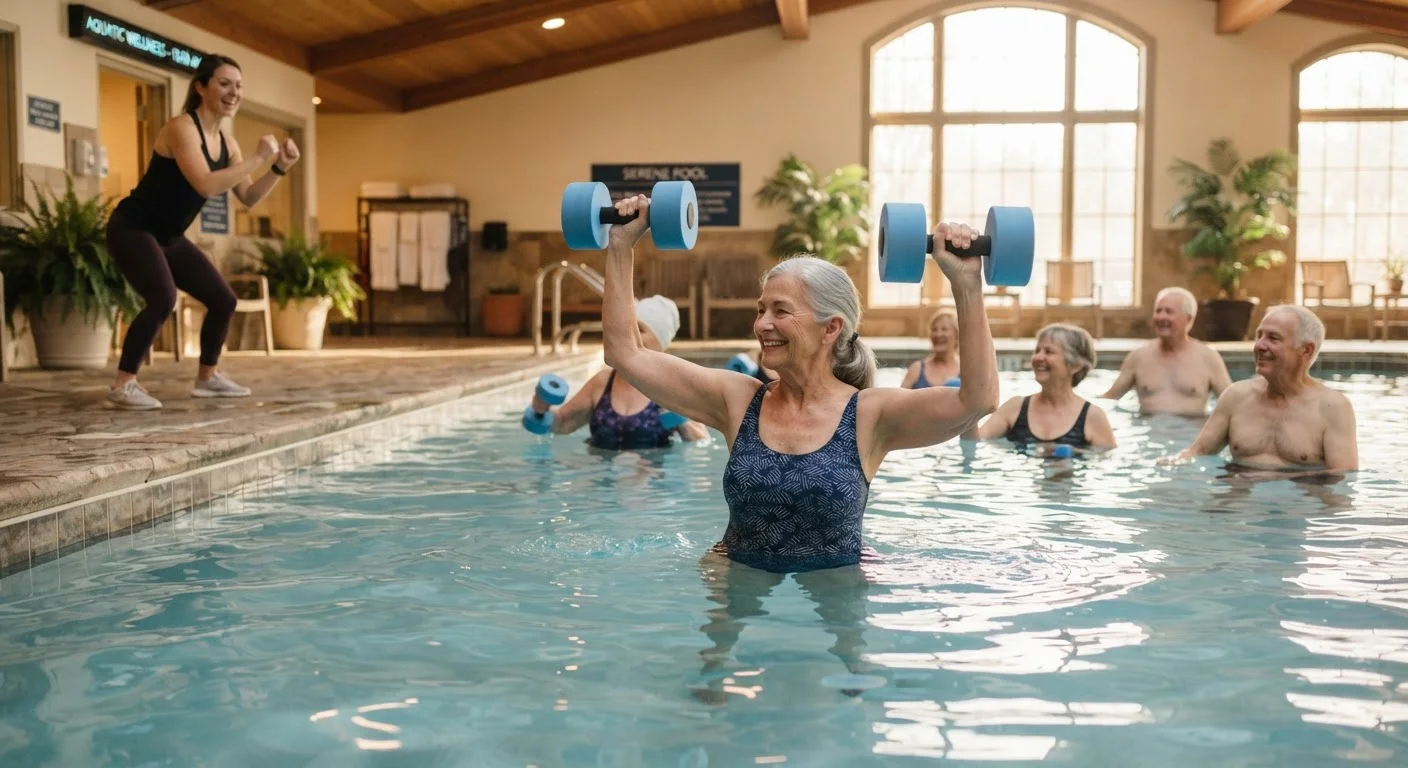
Water is one of the most joint-friendly exercise environments available. Buoyancy reduces the effective weight your joints must bear - submerging to chest depth can reduce lower-body load by roughly 70% - while water resistance still provides meaningful muscular challenge. Aquatic therapy, led by trained professionals, is used in clinical rehabilitation settings. Community water aerobics classes offer a more social, accessible version of the same principle.
Water exercise is particularly well-supported by evidence for osteoarthritis management and is suitable for people with significant mobility limits. Even gentle walking in a pool can improve circulation and range of motion.
Chest-deep water can reduce lower-body joint load by roughly 70%, making it ideal for pain-limited individuals.
Chair Yoga and Seated Stretching
Yoga adapted for a chair removes the floor transitions that make traditional yoga inaccessible to many people with balance issues, hip replacements, or severe joint pain. Chair yoga focuses on gentle stretching, controlled breathing, and range-of-motion work - all performed while seated or using the chair for support.
Beyond flexibility, chair yoga has been studied for its effects on pain perception, mood, and functional independence in older adults. Understanding the difference between flexibility and mobility can help you get more from these sessions.
Chair yoga delivers range-of-motion and stress-reduction benefits without requiring any floor work.
Stationary Cycling
Cycling - whether on a stationary bike, recumbent bike, or cycle ergometer - is a low-impact cardiovascular option that keeps the knee and hip joints moving through a controlled, circular range of motion. Because feet remain on the pedals throughout, there's no impact force like that found in walking on hard surfaces.
Recumbent bikes offer added back support and are especially useful for people with lower-back involvement or significant balance concerns. Resistance can be adjusted to begin at very low intensity and progressed gradually over time as strength and tolerance improve.
Recumbent cycling provides cardiovascular benefits while supporting the back and virtually eliminating joint impact.
Tai Chi
Tai chi is a slow, flowing martial art practiced at low intensity, emphasizing weight shifting, balance, and coordinated movement. It has one of the strongest evidence bases among mind-body practices for people with chronic joint conditions. Studies have found it helpful for reducing knee pain in osteoarthritis, improving balance to reduce fall risk, and supporting overall physical function in older adults.
Classes are widely available in community centers, senior centers, and increasingly online - often at low or no cost. It requires no special equipment and can be modified for those who need to remain seated for portions of the practice.
Tai chi has strong evidence supporting its role in reducing joint pain and improving balance in older adults.
Resistance Band and Light Strength Training
Strengthening the muscles that surround and support joints is a key strategy for long-term pain management - particularly for the knees and hips. Weak quadriceps, for example, are strongly associated with worsened knee osteoarthritis outcomes. Resistance bands allow progressive, controlled strengthening with minimal joint loading and no heavy weights required.
Many exercises can be performed seated or lying down, making this option accessible even for those with significant limitations. A physical therapist can help identify which muscle groups most need attention for your specific situation and show you correct form to avoid aggravating existing issues.
Strengthening muscles around painful joints is one of the most effective long-term strategies for reducing discomfort.
Walking on Softer Surfaces
Standard walking on pavement carries more joint impact than some people realize, but that doesn't mean walking is off the table. Choosing softer surfaces - grass, packed dirt trails, rubberized tracks, or indoor mall floors - can meaningfully reduce impact compared to concrete or asphalt.
Using well-cushioned footwear appropriate for your foot mechanics also helps absorb force. Walking remains one of the most accessible and evidence-supported forms of physical activity for overall health. If you're just getting started or returning after a long break, a structured approach to building a walking routine from scratch can help you progress safely.
Choosing softer surfaces and cushioned footwear can significantly reduce the joint impact of everyday walking.
Finding Your Starting Point
The right starting point looks different for everyone. Someone managing mild knee osteoarthritis has different needs than someone recovering from hip surgery or living with a chronic pain condition. Matching the activity to your current capacity - not an idealized version of it - is the most sustainable approach.
Progress Gradually and Track How You Feel
A common guideline in exercise science is to increase activity duration or intensity by no more than about 10% per week - a general principle sometimes called the '10% rule.' This cautious approach is especially relevant when joint pain is a factor. Keep a simple log of how joints feel during and after activity: mild muscle fatigue is normal, but sharp or worsening joint pain during exercise is a signal to stop and consult a professional.
If you've been largely inactive, a gentle walking routine can be an excellent first step before moving to more structured activities. And if you're building consistency at home, evidence-informed strategies for making home exercise a lasting habit can help you stay on track over time. Movement also supports mental wellbeing - research on exercise and mental health shows nuanced but meaningful benefits worth understanding.
This article is for general informational purposes only and is not a substitute for personalized medical advice. If you have joint pain, a mobility limitation, or any diagnosed health condition, please consult a qualified healthcare professional before beginning or changing an exercise routine.