

What Nutrition Actually Means
Nutrition is the process by which your body takes in and uses food to sustain life, support growth, and maintain health. It encompasses every nutrient your body requires - from the carbohydrates that fuel your brain to the trace minerals that keep your immune system functioning. Understanding nutrition doesn't require a science degree; it requires knowing which questions to ask and where to look for reliable answers.
At its core, nutrition science studies how different foods and dietary patterns affect the body over time. While individual responses to food vary based on genetics, lifestyle, and health status, a substantial body of research points to consistent principles that apply broadly. This guide covers those fundamentals - macronutrients, micronutrients, label literacy, hydration, and habit formation - so you can build a clearer, more confident relationship with what you eat.
This article is for general informational and educational purposes only and is not a substitute for advice from a qualified healthcare or registered dietitian professional.
Macronutrients: The Big Three
Macronutrients are the nutrients your body needs in relatively large quantities because they provide energy, measured in calories. The three macronutrients are carbohydrates, protein, and fat.
- Carbohydrates are the body's preferred energy source, particularly for the brain and muscles during exercise. They include simple sugars (found in fruit and dairy) and complex carbohydrates (found in whole grains, legumes, and vegetables). Fiber - a form of carbohydrate humans can't digest - supports gut health and helps regulate blood sugar levels.
- Protein provides the amino acids your body uses to build and repair tissues, produce enzymes, and support immune function. Complete proteins contain all nine essential amino acids and are found in animal products and some plant sources like soy and quinoa. Incomplete proteins, found in most plant foods, can be complemented by eating a variety of foods throughout the day.
- Fat is essential for absorbing fat-soluble vitamins (A, D, E, and K), supporting cell structure, and producing hormones. Unsaturated fats - found in olive oil, nuts, avocados, and fatty fish - are associated with cardiovascular health. Saturated fats should be consumed in moderation according to major dietary guidelines.
When evaluating any packaged food, check the serving size before anything else - it anchors every other number on the label and is frequently smaller than what most people actually eat.
Misreading serving sizes is one of the most common errors consumers make when trying to manage calorie or nutrient intake, according to FDA consumer research.
Rather than overhauling your entire diet at once, identify one meal of the day to gradually improve - adding a vegetable, swapping a refined grain for a whole grain, or reducing added sugar in a beverage. Small consistent changes compound over time.
Behavioral research on habit formation consistently shows that incremental changes are more sustainable than large, abrupt dietary overhauls.
When assessing your hydration, the simplest daily check is urine color - pale yellow generally indicates adequate hydration, while dark yellow or amber suggests you need more fluids.
Urine color is a practical, validated rough indicator of hydration status recommended by sports medicine and public health practitioners alike.
A common misconception is that one macronutrient is inherently «bad.» Current research consistently shows that dietary quality and overall pattern matter more than isolating any single nutrient.
Micronutrients: Small Amounts, Big Impact
Vitamins and minerals are called micronutrients because your body needs them in much smaller amounts than macronutrients - but that doesn't diminish their importance. Deficiencies in key micronutrients can affect energy, immunity, bone health, and cognitive function.
Vitamins fall into two categories: fat-soluble (A, D, E, K) and water-soluble (C and the B vitamins). Fat-soluble vitamins are stored in body tissue; water-soluble vitamins are not stored as readily and need more consistent replenishment through food. Key minerals include calcium (bone structure), iron (oxygen transport), magnesium (nerve and muscle function), and potassium (blood pressure regulation).
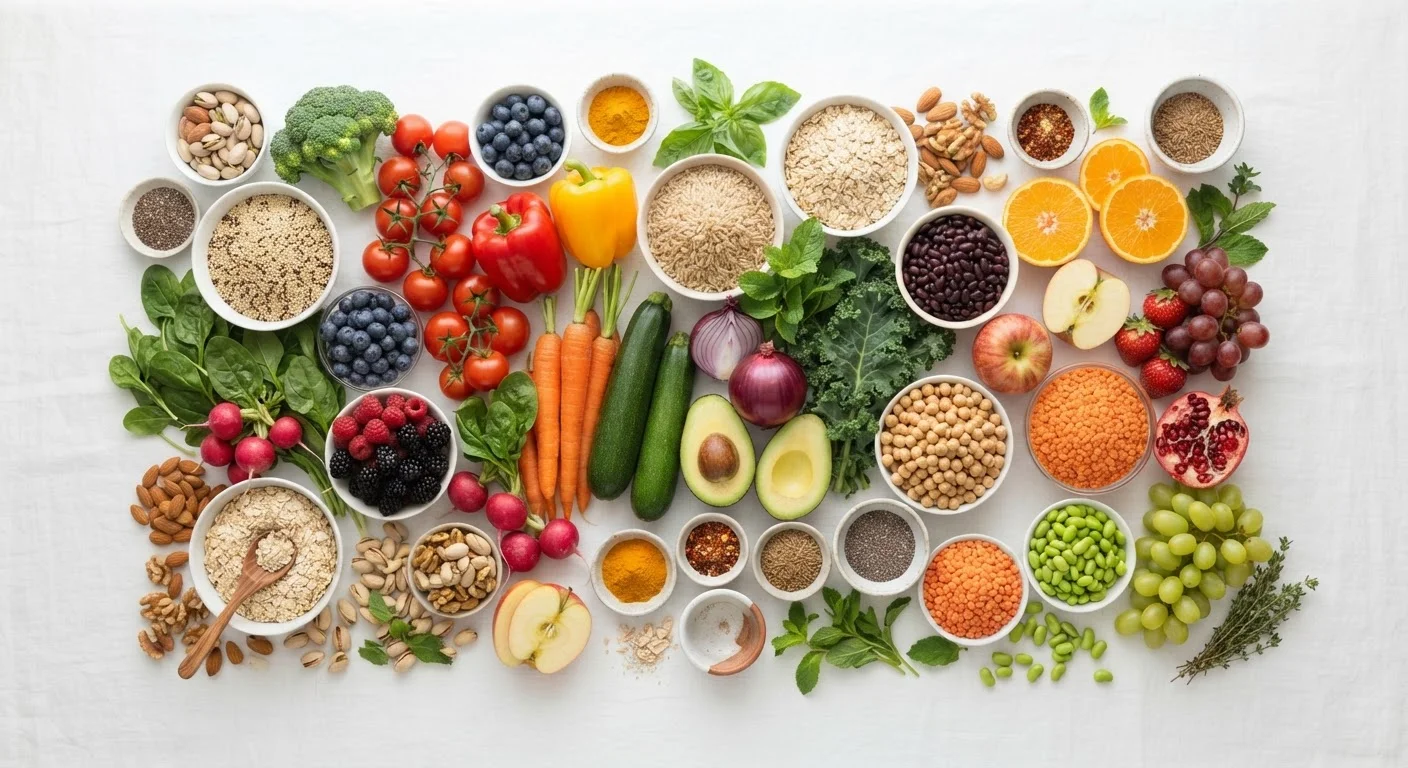
Eating a wide variety of whole foods - vegetables, fruits, whole grains, legumes, nuts, seeds, and lean proteins - is the most reliable way to meet micronutrient needs without supplementation. If you suspect a deficiency, a healthcare provider can order appropriate testing before recommending supplements. Self-supplementing without guidance can occasionally cause harm, particularly with fat-soluble vitamins that accumulate in tissue.
90%+
Americans falling short on dietary fiber
The USDA's Dietary Guidelines Advisory Committee has consistently found that dietary fiber is one of the most widespread nutrient shortfalls in the American diet.
~40%
U.S. adults with vitamin D insufficiency
According to data from the National Health and Nutrition Examination Survey (NHANES), a substantial portion of American adults have suboptimal vitamin D levels.
17 tsp
Average daily added sugar intake, U.S. adults
CDC data estimates average American adults consume around 17 teaspoons of added sugar per day - well above the recommended limit of 12 teaspoons for a 2,000-calorie diet.
Decoding Food Labels
Nutrition Facts labels are required on most packaged foods in the United States, and they contain far more useful information than most shoppers realize. Knowing how to read them is a concrete skill that improves every grocery run. For a full walkthrough, see our guide to reading nutrition labels.
Here are the most important elements to understand:
- Serving size: Everything on the label - calories, nutrients, percentages - refers to one serving, not the whole package. Check the number of servings per container first.
- Calories: A general measure of the energy the food provides. Calorie needs vary significantly by age, sex, body size, and activity level.
- % Daily Value (%DV): This percentage is based on a 2,000-calorie reference diet. As a rule of thumb, 5% DV or less is considered low for a nutrient; 20% DV or more is considered high. Use this to compare products or to ensure you're getting enough of nutrients like fiber, calcium, and vitamin D.
- Added sugars vs. total sugars: Total sugars include naturally occurring sugars (from fruit or dairy); added sugars are those incorporated during processing. The Dietary Guidelines for Americans recommend limiting added sugar intake.
- Ingredient list: Ingredients are listed by weight, heaviest first. Shorter lists with recognizable ingredients generally indicate less processing - though this isn't a hard rule.
Hydration and Its Role in Nutrition
Water is often left out of nutrition conversations, but it is arguably the most essential nutrient. Every cell, tissue, and organ in the body requires water to function. Hydration affects digestion, nutrient transport, temperature regulation, kidney function, and even mood and cognitive performance.
The National Academies of Sciences, Engineering, and Medicine suggest a general adequate intake of about 3.7 liters (125 oz) of total water daily for men and 2.7 liters (91 oz) for women - from all sources, including food. Roughly 20% of daily water intake typically comes from food, especially fruits and vegetables.
Signs of inadequate hydration can include fatigue, headaches, difficulty concentrating, and dark-colored urine. Needs increase with physical activity, hot weather, illness, or pregnancy. Plain water is the most efficient hydration source; beverages with added sugar or high caffeine content may offset some hydration benefits.
Building Long-Term Eating Habits
Short-term diets produce short-term results. Research consistently shows that dietary patterns maintained over years - not weeks - are what drive meaningful health outcomes. The goal is to build a way of eating that is flexible, enjoyable, and grounded in whole foods.
Several well-studied dietary patterns offer a useful framework:
- Mediterranean-style eating emphasizes vegetables, fruits, whole grains, legumes, olive oil, and fish - with moderate dairy and limited red meat. It is among the most researched patterns associated with cardiovascular and cognitive health.
- Dietary Approaches to Stop Hypertension (DASH) was originally developed to support blood pressure management and focuses on reducing sodium while increasing potassium, calcium, and magnesium through food.
- Plant-forward eating doesn't require eliminating animal products but shifts the emphasis toward plant-based whole foods. Even partial shifts - like reducing red meat frequency - are associated with health benefits in population studies.
For a practical starting point, our beginner's guide to balanced eating breaks down simple, sustainable principles anyone can apply today.
Practical habit-building tips that research supports include cooking at home more frequently, planning meals ahead, eating without screens, and not treating any food as permanently off-limits - restriction often fuels craving.
Nutrition Across Life Stages
Nutritional needs are not static. They shift significantly as the body grows, matures, reproduces, and ages. A teenager in peak growth, a pregnant person, and an adult over 65 have meaningfully different nutrient priorities - and applying general adult advice across all life stages can leave important gaps.
Key shifts include:
- Childhood and adolescence: Higher needs for calcium and vitamin D support bone development; iron needs increase sharply in adolescent girls after menstruation begins.
- Pregnancy and breastfeeding: Folate (to support neural tube development), iron, iodine, and omega-3 fatty acids become particularly important. Anyone who is or may become pregnant should consult a healthcare provider about appropriate supplementation and dietary guidance specific to their situation.
- Older adulthood: Protein needs may increase to preserve muscle mass; vitamin B12 absorption can decline with age; calcium and vitamin D remain critical for bone density. Appetite often decreases even as nutrient needs persist.
For a detailed map of how nutritional priorities evolve from youth through older adulthood, see our resource on nutrition through the life stages.
If you have children, are pregnant, are managing a chronic condition, or are an older adult, personalized guidance from a registered dietitian or physician is especially valuable - general population advice may not account for your specific needs.
This article is for general informational and educational purposes only and does not constitute medical or dietary advice. Consult a qualified healthcare professional or registered dietitian for guidance tailored to your individual health needs.