

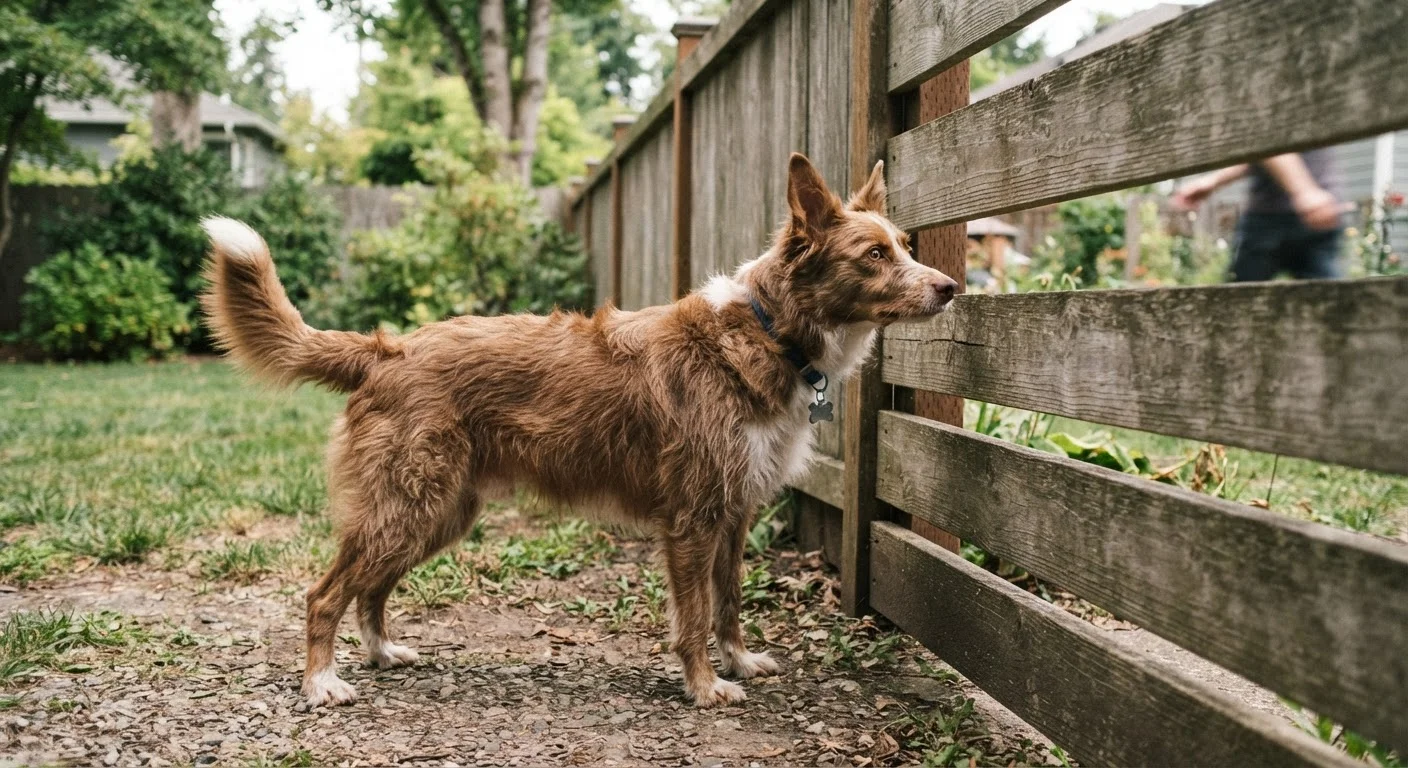
What Territorial Behavior Actually Looks Like
Territorial behavior in dogs is an evolutionary inheritance. Wolves and their domestic descendants are wired to monitor and defend resources - a den, food sources, and members of their social group. In modern pet dogs, this instinct often surfaces as barking, growling, or alert posturing when someone approaches the home, yard, or car.
The defining characteristic of territorial behavior is its context-dependence. It tends to occur at the perceived boundary - the fence line, the front door, the edge of the yard - and typically de-escalates once the trigger (the visitor, the delivery driver) moves away. The dog registers the intrusion, signals it, and returns to baseline.
Body language during territorial responses often includes a stiff, upright posture, raised tail, forward-pitched ears, and direct eye contact toward the perceived intruder. Vocalization is common, but the dog is usually oriented toward the boundary, not the owner. For a deeper look at these physical signals, see our guide to reading your pet's body language.
| Criterion | Territorial Behavior | Aggression |
|---|---|---|
| Primary trigger | Boundary approach or perceived intruder | Varies: fear, pain, frustration, or territory |
| Location dependence | Strongly tied to home, yard, or vehicle | Can occur in any location |
| Predictability | Generally consistent and context-specific | Variable; may appear without clear trigger |
| De-escalation pattern | Usually settles when threat leaves | May persist or escalate after trigger passes |
| Body language | Stiff, alert, oriented toward boundary | Crouched, tense, or explosive depending on type |
| Professional help needed | If disproportionate or unmanageable | Strongly recommended, especially after a bite |
How Aggression Differs - and Why It Matters
Aggression is a broader behavioral category that encompasses many different motivational states: fear, pain, frustration, redirected arousal, predatory drive, and yes - sometimes territorial instinct pushed to an extreme. While territorial behavior is a subset of how aggression can express itself, not all aggression is territorial.
A key distinction is predictability and trigger consistency. Territorial behavior tends to follow a clear pattern tied to location and approach. Aggression rooted in fear or pain may appear without obvious boundary cues - a dog may snap when touched unexpectedly, lunge at strangers on a walk, or react intensely in spaces far from home territory.
Owners often misread fear-based aggression as dominance or stubbornness - a mistake that leads to ineffective responses. Our article on commonly misread pet behaviors covers these misinterpretations in detail.
Territorial Behavior Can Escalate Into Aggression
Territorial responses exist on a spectrum. A dog that starts by barking at the fence may - if consistently ignored, under-socialized, or anxious - escalate toward lunging or snapping. This is one reason early management matters. Territorial instinct alone isn't a problem; unchecked escalation is.
It's also worth noting that resource guarding - where a dog reacts to people or other animals approaching food, toys, or a resting spot - is a related but distinct behavior. Learn more in our article on responding to resource guarding in dogs.
When to Seek Professional Help
Territorial behavior that stays proportionate and predictable can often be managed through consistent training, clear structure, and controlled socialization. Dogs that alert and then settle, who respond to owner redirection, and whose reactions are tied reliably to boundary contexts generally fall within a manageable range.
However, aggression that is escalating, unpredictable, or has resulted in a bite should always be evaluated by a professional - ideally a board-certified veterinary behaviorist or a certified applied animal behaviorist. Pain-related aggression in particular is frequently missed: a dog that suddenly snaps may be experiencing an undiagnosed medical issue rather than a behavioral one. A veterinary exam is often the right first step.
Punishment-based responses to either behavior can worsen the underlying issue by increasing anxiety or suppressing warning signals without resolving the root cause. Dogs that stop growling after punishment haven't necessarily become safer - they may simply have lost their warning system. If your dog's behavior is affecting daily life or safety, a professional evaluation is the appropriate course of action, not a delay.
This article is for general informational purposes only and is not a substitute for professional veterinary or behavioral advice. If your dog has shown aggressive behavior, please consult a qualified veterinary or animal behavior professional.