

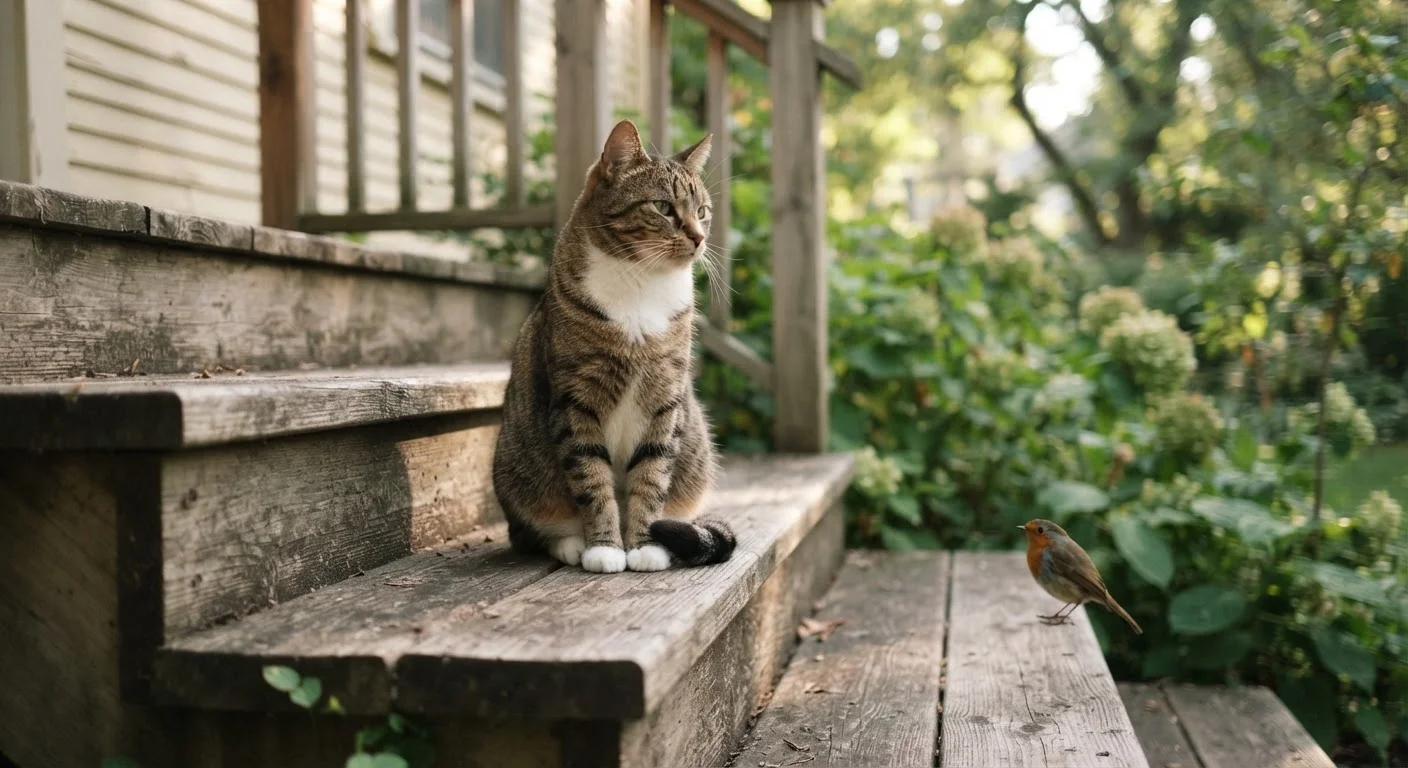
The Instinct Behind the Offering
If you've ever opened your door to find a mouse, bird, or lizard deposited at your feet, you've witnessed one of domestic cats' most misunderstood behaviors. Owners routinely assign human motives to this act - pride, affection, or even spite - but the real explanation is far more rooted in biology than emotion.
Cats are obligate carnivores and hardwired predators. Even well-fed house cats retain the full predatory sequence inherited from their wild ancestors: stalk, pounce, catch, kill, and retrieve. This sequence doesn't switch off just because food arrives in a bowl. What changes in a domestic setting is where the prey ends up - and that's often your living room floor.
Researchers who study feline behavior generally agree that bringing prey home is an extension of natural caching behavior. In the wild, cats transport kills to a safe location to eat undisturbed or to feed dependent young. Your home, from your cat's perspective, is simply the safest location it knows. For more on how cats express themselves through instinct-driven actions, see our breakdown of common feline behaviors.
Myth
My cat is bringing me a gift because it loves me and wants to share.
Fact
The behavior is driven by predatory instinct and caching, not emotional generosity.
The idea of a cat "gifting" prey is a human projection. While cats do form attachments to their owners, the act of transporting prey home is not an intentional gesture of affection. It reflects an instinctive drive to retrieve a catch to a safe, familiar location - which happens to be your home. The behavior is the same whether or not anyone is watching.
Myth
My cat brings dead animals because it's angry with me or acting out.
Fact
Cats have no documented capacity for revenge. This behavior has no punitive motive.
Revenge requires a theory of mind - the ability to understand that another individual has feelings that can be intentionally hurt. Current animal cognition research does not support the idea that domestic cats plan retributive actions. Bringing prey home is a reflexive expression of hunting instinct, not a response to perceived mistreatment. If your cat's behavior changes after a disruption in routine, stress is a more likely explanation than spite. See how owners frequently misread pet behavior for more context.
Myth
A well-fed cat won't bother hunting.
Fact
Hunger and hunting are controlled by separate neurological systems in cats.
This is one of the most persistent misconceptions about cat behavior. Research in feline neurology confirms that the drive to hunt is decoupled from hunger. A fully satiated cat will still stalk, pounce, and capture prey - because the reward circuitry activated by hunting is independent from the signals that regulate appetite. Feeding your cat more will not reduce its predatory behavior.
Myth
If my cat brings home prey, it must not be getting enough stimulation indoors.
Fact
Outdoor hunting reflects opportunity and instinct, not a deficiency in the home environment.
While enrichment is genuinely important for cat welfare, the presence of hunting behavior in outdoor cats isn't a signal that something is wrong inside the home. Cats hunt because they can and because their neurology rewards them for it. That said, increasing interactive play can partially redirect the predatory sequence and may reduce hunting frequency in some cats - making it a worthwhile practice regardless. For related insights, the nocturnal behavior patterns in domestic cats article explores similar instinct-driven activity cycles.
Myth
Only outdoor cats with a 'wild' background do this - domesticated cats have lost these instincts.
Fact
All domestic cats retain full predatory instincts regardless of how many generations they've lived indoors.
Domestication has altered many aspects of cat behavior and physiology, but the predatory sequence is remarkably intact. Even cats bred and raised exclusively indoors will stalk, pounce on, and "kill" toys with the same neurological engagement as a feral cat hunting in the field. The instinct is conserved because it is hardwired, not learned. What domestication changes is context and frequency - not the underlying drive.
Who Does This Most - and Why
Not every cat brings home prey with the same frequency. Several factors influence how often this behavior appears:
- Sex and reproductive status: Unspayed female cats show this behavior most reliably. In the wild, mother cats bring prey to kittens to teach hunting - some ethologists suggest that females with no kittens redirect this instinct toward their human housemates.
- Outdoor access: Cats with regular outdoor time have far more opportunity to hunt. Indoor-only cats may bring toy prey or chase bugs instead.
- Individual prey drive: Like any trait, hunting intensity varies between individual animals. Some cats are persistent hunters; others show little interest.
- Age: Younger cats and adolescents tend to hunt more actively, though many older cats maintain the behavior throughout their lives.
Understanding which cats are most likely to hunt can help owners take practical steps to reduce wildlife impact without penalizing a natural behavior. This connects to broader questions about behaviors owners frequently misread in pets.
Don't Handle Prey With Bare Hands
If your cat brings in a live or recently killed animal, avoid handling it without protection. Some wild animals can carry zoonotic diseases - illnesses transmissible from animals to humans - including rabies in certain regions. Use gloves or a plastic bag to dispose of the animal, and wash your hands thoroughly afterward. Contact your local animal control or health department if you're unsure about disease risk in your area.
What You Can Actually Do About It
Scolding or punishing your cat after the fact accomplishes nothing useful - cats do not connect after-the-fact corrections to previous actions, and punishment may create stress without changing the behavior. Instead, focus on practical interventions:
- Keep cats indoors: The most effective way to prevent hunting is to eliminate outdoor access. Indoor cats can live full, enriched lives with appropriate play, climbing structures, and mental stimulation.
- Use a bell collar: Studies, including one published in Applied Animal Behaviour Science, suggest that brightly colored collar covers and bells can reduce bird and small mammal catches by a measurable margin - though results vary by individual cat.
- Increase structured play: Providing regular, interactive play sessions with wand toys or puzzle feeders can partially satisfy the predatory drive before your cat heads outside.
- Supervise outdoor time: Leash walking or enclosed outdoor structures (sometimes called catios) allow outdoor stimulation while limiting hunting range.
If your cat is an outdoor hunter, it's also worth knowing that prey animals can carry parasites and secondary toxins from pest control. Have your veterinarian assess your cat's parasite prevention plan accordingly. You may also find it useful to review common pet care myths that can affect your approach to feline health.