
How Each Mortgage Type Works
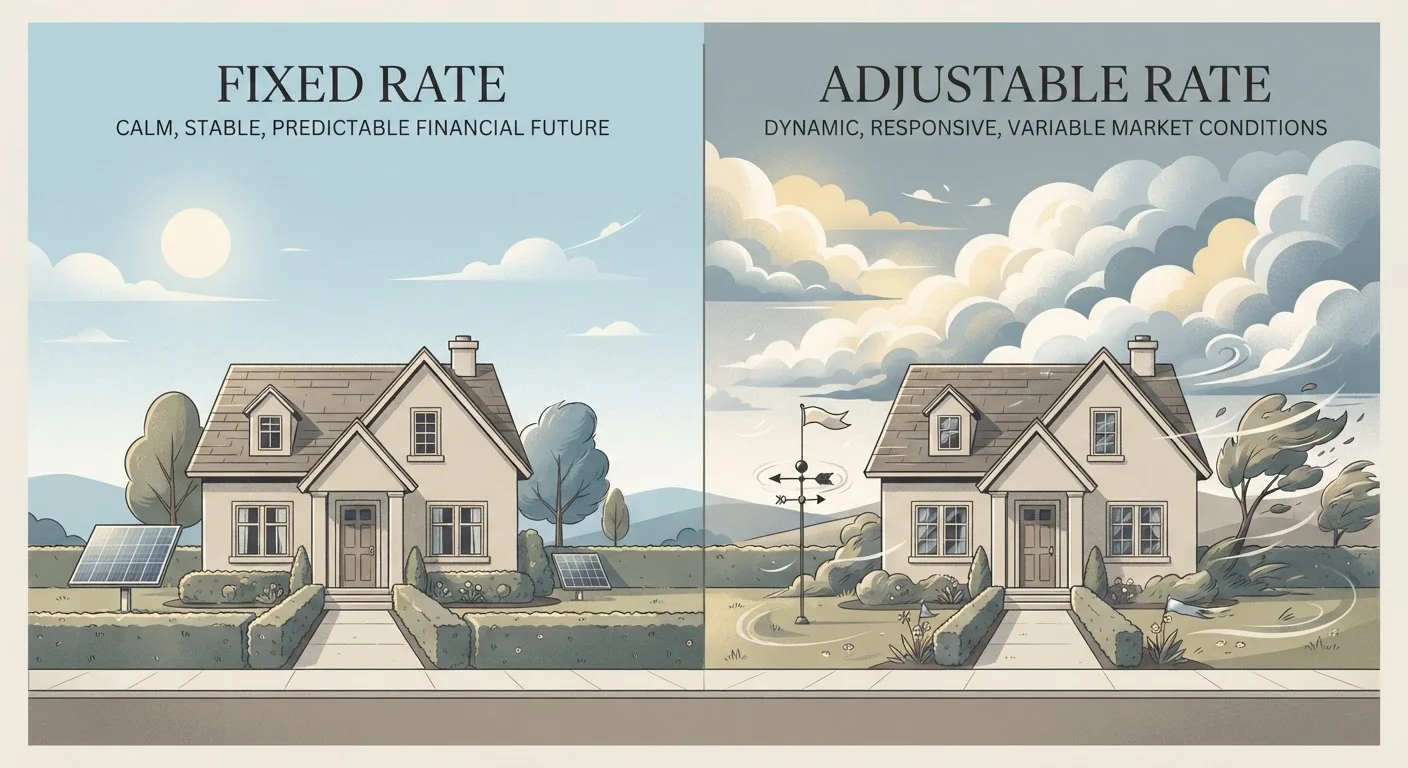
A fixed-rate mortgage is straightforward: the interest rate is set at closing and never changes. Whether you have a 15-year or 30-year term, your principal-and-interest payment stays the same from month one to the final payment. This makes long-term budgeting simple and insulates you completely from market rate fluctuations.
An adjustable-rate mortgage (ARM) works differently. It begins with a fixed-rate introductory period - commonly 5, 7, or 10 years - followed by periodic adjustments tied to a benchmark interest rate index, such as the Secured Overnight Financing Rate (SOFR). The loan name often reflects this structure: a 5/1 ARM has a fixed rate for 5 years, then adjusts annually. Most ARMs include rate caps that limit how much the rate can move at each adjustment and over the life of the loan, offering some protection against extreme increases.
| Criterion | Fixed-Rate Mortgage | Adjustable-Rate Mortgage (ARM) |
|---|---|---|
| Interest Rate | Locked for entire loan term | Fixed initially, then adjusts periodically |
| Monthly Payment | Constant throughout loan life | Can increase or decrease after intro period |
| Starting Rate | Typically higher than ARM | Typically lower than fixed-rate |
| Rate Risk | None - rate is fixed | Rate can rise after adjustment period |
| Best Loan Term | 15 or 30 years | 5/1, 7/1, or 10/1 common structures |
| Ideal Holding Period | Long-term (10+ years) | Short-to-medium term (under 7-10 years) |
| Budgeting Ease | Very easy - payment never changes | Harder after intro period ends |
The Real Trade-Offs to Weigh
The core tension comes down to certainty versus cost. Fixed-rate mortgages typically carry a higher starting rate than ARMs, because lenders price in the risk of being locked into that rate for decades. You're essentially paying a premium for predictability.
ARMs, by contrast, offer lower initial rates - which translates to lower early payments and potentially thousands of dollars saved if you sell or refinance before the adjustment period begins. However, you're accepting the possibility that your rate - and payment - could increase meaningfully after the introductory period.
Understanding ARM Rate Caps
Most ARMs include three types of caps: an initial cap (limits the first rate change), a periodic cap (limits each subsequent adjustment), and a lifetime cap (limits total rate increase over the loan's life). For example, a 2/2/5 cap structure means the rate can rise at most 2% at first adjustment, 2% at each subsequent adjustment, and no more than 5% above the initial rate overall. Review your loan's cap structure carefully before signing.
How long you plan to stay in the home is often the clearest guide. If you're confident you'll move within the ARM's fixed window, the rate adjustment risk may never materialize. If you're planting roots for the long haul, the consistency of a fixed rate often outweighs its higher starting cost. For a broader look at how mortgage strategy fits into overall ownership decisions, see the long-term trade-offs of carrying a mortgage.
What Shapes the Decision Beyond Rate Type
Several financial and personal factors deserve careful consideration before committing to either structure:
- Your credit profile: A stronger credit score typically unlocks more competitive rates on both loan types. Understanding how lenders evaluate creditworthiness - a concept that applies equally to home loans and auto financing - helps you approach any application prepared.
- Current rate environment: When prevailing rates are relatively low, locking in a fixed rate is more attractive. When fixed rates are elevated, the spread between fixed and ARM rates often widens, making an ARM more compelling for short-term holders.
- Loan term: A 15-year fixed mortgage carries a lower rate than a 30-year fixed but demands a higher monthly payment. Shorter terms reduce total interest paid significantly.
- Income stability: If your income is steady and predictable, an ARM's variability may be manageable. If your earnings fluctuate, fixed payments reduce financial stress.
30 years
Most common fixed-rate mortgage term in the U.S.
The 30-year fixed-rate mortgage has historically been the most widely chosen home loan structure among American borrowers, according to Freddie Mac survey data.
~1-2%
Typical initial rate advantage of ARMs over fixed loans
Historically, the spread between a 5/1 ARM and a 30-year fixed-rate mortgage has ranged from roughly one to two percentage points, though this varies with market conditions.
If you're still weighing whether homeownership itself is the right step, explore the rent-vs-buy decision without pressure before focusing on mortgage structure.