

How Lenders Decide What Rate to Offer You
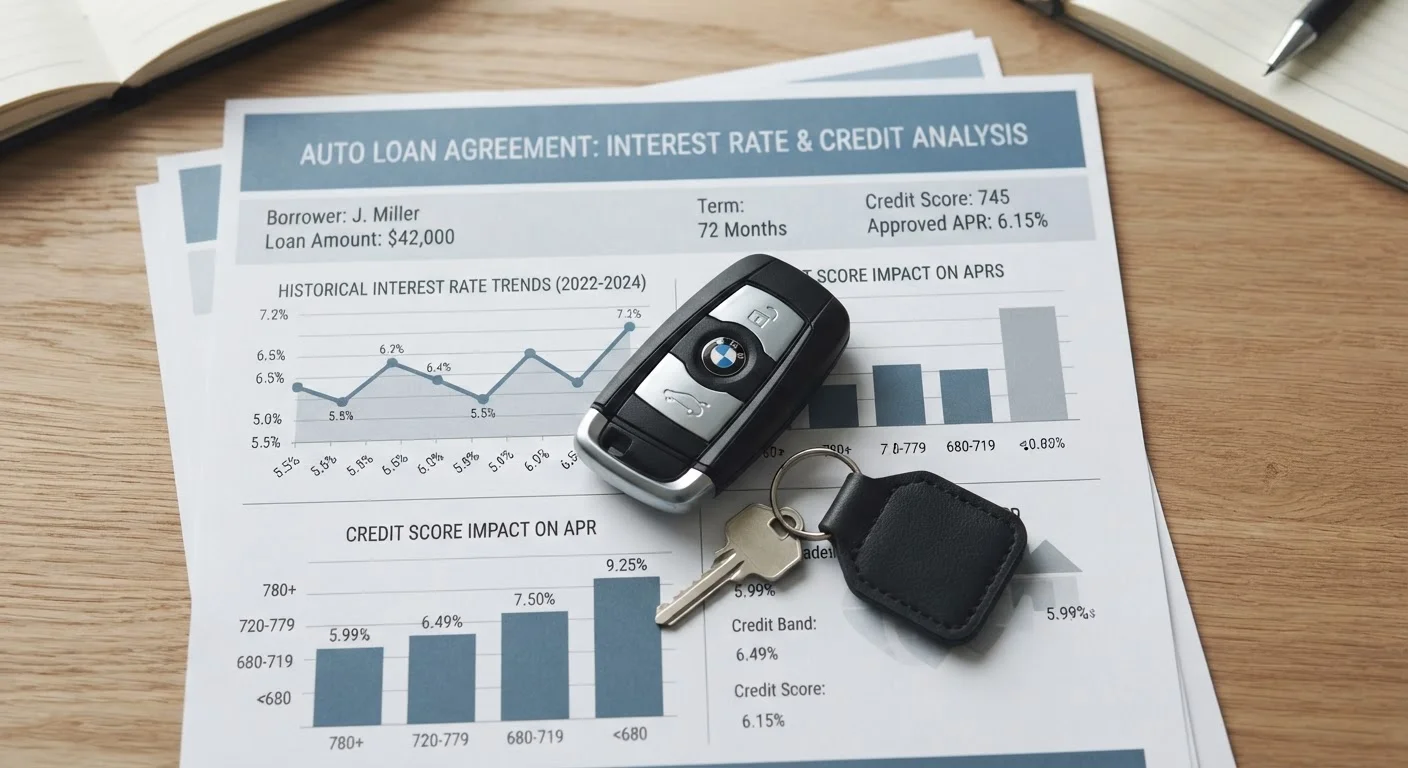
Auto lenders don't set interest rates arbitrarily. They use your credit score - along with your credit history, debt load, and income - to estimate the likelihood you'll repay the loan on time. This risk assessment is then mapped to a credit tier, and each tier corresponds to a rate range.
Broadly, tiers work like this: borrowers with the strongest credit profiles qualify for rates closest to the lender's lowest available APR. As scores decline, the offered rate rises to compensate the lender for the additional risk. Borrowers in the lowest tiers - sometimes called subprime - may face rates that are two to three times higher than those offered to top-tier applicants.
It's worth understanding that lenders also factor in the loan term and whether the vehicle is new or used. Used car loans typically carry higher rates than new car loans at equivalent credit tiers, because used vehicles depreciate faster and carry more valuation uncertainty for the lender. See how depreciation affects vehicle value for more context on why lenders treat new and used loans differently.
~$10,000+
Extra interest paid by subprime vs. prime borrowers
Illustrative estimate on a $28,000, 60-month auto loan comparing a 5% APR to an 18% APR.
720+
Credit score often needed for top-tier auto loan rates
Industry-standard credit tier thresholds used by many auto lenders to assign rate categories.
14-45 days
Rate-shopping window treated as one inquiry
Under common credit scoring models, auto loan inquiries clustered in this window count as a single hard pull.
The Real Dollar Impact Across Credit Tiers
Abstract percentages become very concrete when you run the numbers on an actual loan. Consider a $28,000 loan over 60 months. A borrower in the top credit tier might receive an APR of around 5%, resulting in a monthly payment near $528 and roughly $3,700 in total interest. A borrower in a mid-range tier at 10% APR pays about $595 per month - the same car, about $4,000 more over five years. A subprime borrower at 18% APR faces payments near $710 per month and pays over $14,500 in interest.
That's a difference of more than $10,000 in total cost for the same vehicle, same loan amount, and same loan term - driven entirely by credit score. This is why understanding your credit profile before you walk into a dealership matters so much.
For a fuller picture of what a car actually costs to own beyond the loan, see the total cost of car ownership.
Get Your Rate Before You Get to the Lot
Walking into a dealership with a pre-approval letter from your bank or credit union means you already know your baseline rate. Dealership financing may still beat it - but you'll have a concrete number to compare against rather than relying on what the finance office tells you. This single step shifts negotiating leverage significantly in your favor.
Steps You Can Take Before You Finance
Your credit score isn't fixed - it's a snapshot. Before financing a vehicle, there are several practical steps worth taking:
- Pull your free credit reports. Check all three major bureau reports for errors. Incorrect late payments or accounts that aren't yours can suppress your score unfairly. Disputing errors takes time, so do this well before you need financing.
- Understand where you land. Many banks and credit card issuers provide free credit score access. Knowing your tier in advance removes surprises at the dealership.
- Get pre-approved before shopping. Applying directly with a bank or credit union gives you a firm rate offer to carry into the buying process. Financing through a dealership versus your own lender involves meaningful trade-offs worth understanding before you sign anything.
- Limit new credit activity beforehand. Opening new credit cards or taking on other debt in the months before applying can nudge your score downward.
Auto insurance costs are another credit-adjacent financial consideration - some states allow insurers to factor credit-based insurance scores into premium calculations. How auto insurance premiums are calculated explains the broader set of variables at play.