

Why This Decision Deserves a Clearer Framework
Few financial topics generate more unsolicited advice than whether to rent or buy a home. The pressure to buy - often framed as the "responsible" or "smart" move - can obscure a more honest reality: renting is a legitimate, financially rational housing choice in many situations.
The goal here isn't to push you toward either path. It's to help you think through the factors that actually matter for your life, not some abstract ideal. For a deeper look at the full financial picture beyond monthly payments, see the real trade-offs beyond the monthly payment.
The True Costs on Both Sides
Monthly payment comparisons are a starting point, not the full picture. Renters pay rent plus utilities and renters insurance - costs that are generally predictable. Buyers take on a mortgage payment, but also property taxes, homeowners insurance, HOA fees (where applicable), and ongoing maintenance. Industry guidance commonly suggests budgeting 1-2% of a home's purchase price annually for maintenance alone.
| Renting | Buying | |
|---|---|---|
| Monthly cost predictability | Fixed rent term; subject to renewal increases | Fixed mortgage possible; taxes/insurance vary |
| Upfront costs | Security deposit + first/last month's rent | Down payment + 2-5% closing costs |
| Maintenance responsibility | Landlord handles most major repairs | Owner responsible for all costs |
| Flexibility to relocate | High - typically 30-60 day notice | Low - selling involves time and significant cost |
| Equity building | None through housing payments | Builds over time through payments and appreciation |
| Exposure to market risk | None - no ownership stake | Values can rise or fall with the market |
| Long-term wealth potential | Depends on investing freed-up capital | Historically significant in many markets |
Renters also retain liquidity - money that would otherwise be tied up in a down payment can remain in savings or investments. Whether that trade-off benefits you depends on how those funds are actually managed and on local market dynamics.
Time Horizon: The Factor Most People Underweight
How long you expect to stay in an area may be the single most important variable. Buying a home involves substantial transaction costs - typically 2-5% in closing costs when purchasing, and another 5-8% in agent commissions and fees when selling. Those costs require time to recoup through equity gains and price appreciation.
A general rule of thumb used by many housing analysts is that buyers who sell within three to five years often don't recover their transaction costs, particularly in flat or declining markets. If there's meaningful uncertainty about where you'll be living in a few years - due to career changes, family circumstances, or personal preference - renting preserves the option to move without a financial penalty.
Use a Break-Even Calculator as a Starting Point
Several nonprofit housing organizations and university extensions offer rent-vs-buy calculators that estimate how many years it takes for buying to break even against renting in a given market. These tools aren't perfect predictors, but they can surface whether your time horizon aligns with ownership making financial sense. Treat the output as one data point, not a decision-maker.
What Renting Actually Gives You
Renting is often framed in terms of what it lacks - no equity, no "ownership." But it comes with real advantages worth naming directly. Renters are not responsible for major repairs: if the furnace fails or the roof leaks, that's the landlord's problem. Renters can relocate with relatively short notice, often 30-60 days depending on lease terms. And renters face no exposure to falling home values.
Understanding your rights as a tenant is equally important. If you're new to renting, what to expect before, during, and after you sign covers the full process from lease review to move-in. Knowing what landlords can and cannot do - on security deposits, habitability standards, and notice requirements - can meaningfully affect the quality of your renting experience.
Financial Readiness: Honest Questions Before You Buy
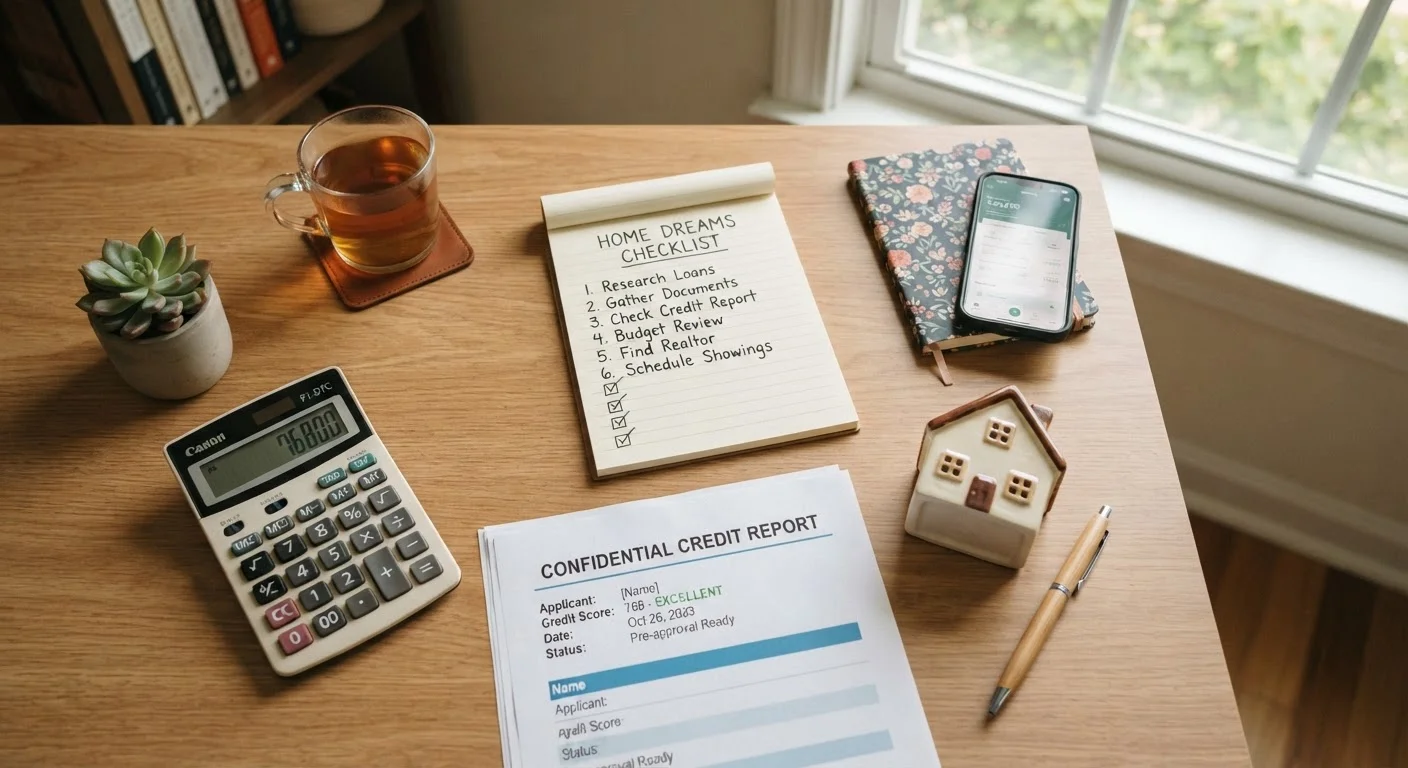
For renters considering a purchase, honest self-assessment matters more than market timing. Key financial benchmarks commonly referenced by housing counselors include: a down payment of at least 3-20% of the purchase price (with lower down payments typically requiring private mortgage insurance), a stable income sufficient to keep total housing costs below roughly 28-30% of gross monthly income, an emergency fund that remains intact after closing, and a credit profile that qualifies for reasonable loan terms.
If you do move toward buying, decisions like whether to pursue a fixed or adjustable rate mortgage involve their own trade-offs - how to think through the mortgage rate choice can help frame that next decision. And for longer-term planning, the trade-offs of owning outright versus carrying a mortgage is worth understanding early.
More broadly, the home buying process involves many layered decisions - financial readiness is the foundation, not the finish line.