
Why the Rust Belt Deserves a Second Look
For decades, the shorthand for cities like Pittsburgh, Detroit, and Cleveland was decline - shuttered factories, population loss, and a collective narrative of what America left behind. That story was always incomplete, and today it's increasingly obsolete. Across the industrial Midwest and mid-Atlantic, former manufacturing hubs are forging identities built on universities, healthcare, arts, and culinary creativity.
This isn't a feel-good spin. These cities still grapple with real inequities, and not every neighborhood has shared equally in whatever revival is underway. But for curious travelers willing to look past the clichés, the Rust Belt offers something genuinely rare: history with texture, culture without pretension, and a pace of life that still has room for you. Here are the cities generating the most compelling reasons to visit.
Pittsburgh, Pennsylvania
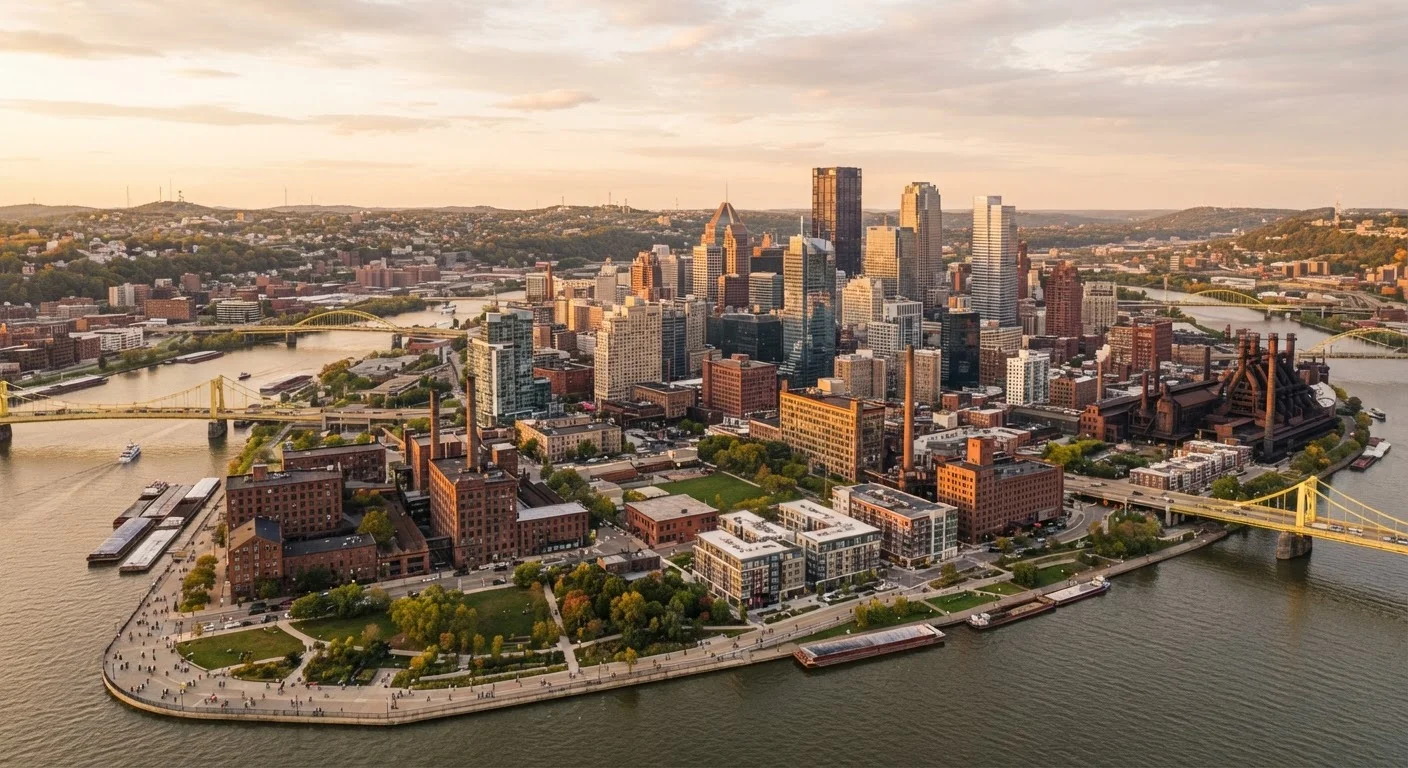
Pittsburgh has arguably pulled off the most dramatic reinvention of any American industrial city. Once defined almost entirely by steel, it now anchors itself around world-class universities, a booming technology and healthcare sector, and a food scene that punches well above its weight. The Strip District's market corridor gives way to Lawrenceville's gallery-lined streets, while the North Shore offers easy access to the rivers that give the city its famously dramatic topography.
The city's museums are quietly exceptional - the Carnegie Museums of Art and Natural History, the Andy Warhol Museum, and the Mattress Factory (a contemporary installation art space) represent a cultural depth that surprises first-time visitors. The funicular railways, locally called inclines, provide both a practical ride and a genuinely spectacular view of downtown from Mount Washington.
Pittsburgh's layered identity - steel town, college city, foodie destination - makes it one of America's most genuinely surprising visits.
Detroit, Michigan
No Rust Belt city carries more myth than Detroit, and few are more misunderstood by people who haven't visited. The city's challenges are real and ongoing, but so is its creative energy. Eastern Market, one of the largest historic public markets in the country, pulses with life on weekend mornings. The Detroit Institute of Arts houses a world-class collection, anchored by Diego Rivera's Detroit Industry Murals - among the most powerful works of public art in America.
Detroit's music heritage (Motown, techno, and a storied rock lineage) is woven into the city's fabric, and a new wave of restaurants, breweries, and independent businesses in neighborhoods like Corktown and Midtown makes it clear this is a city actively reinventing itself on its own terms. Come without assumptions and you'll find a place that's far more alive than its headlines suggest.
Detroit's creativity is homegrown and unfiltered - a city rebuilding on its own terms, not a developer's blueprint.
Cleveland, Ohio
Cleveland gets overlooked even within Rust Belt conversations, which is part of what makes it so rewarding. The Rock and Roll Hall of Fame is the obvious draw, but the city's real depth lies in its neighborhoods. Ohio City and Tremont offer some of the best independent dining in the Midwest, while the West Side Market - a century-old indoor market hall - is a genuinely unmissable stop. University Circle, home to the Cleveland Museum of Art (with free general admission) and the Cleveland Orchestra, represents one of the densest cultural districts of any mid-size American city.
Lake Erie provides a natural backdrop that many visitors don't anticipate, and the Cuyahoga Valley National Park sits just south of the city - an easy day trip for hiking and waterfall spotting.
University Circle's concentration of free world-class cultural institutions makes Cleveland one of America's great underrated day-trip destinations.
Buffalo, New York
Buffalo has been turning the corner for years, and the transformation is now tangible enough to feel on a weekend visit. The city's architectural legacy is extraordinary - Louis Sullivan's Guaranty Building, Frank Lloyd Wright's Darwin Martin House, and H.H. Richardson's Buffalo State Hospital (now a boutique hotel and tour site) make it an essential destination for anyone interested in American architecture.
The Elmwood Village offers a walkable stretch of independent shops, cafés, and restaurants that feels genuinely lived-in rather than curated for visitors. And yes, the food culture here extends well beyond the chicken wings that put Buffalo on the culinary map - though those remain absolutely worth seeking out.
Buffalo's architectural heritage is world-class and largely unsung - a must-visit for design-curious travelers.
Youngstown, Ohio
Youngstown is the most raw and honest entry on this list - a city that has faced some of the steepest population decline of any American urban center and hasn't yet emerged with a tidy revival narrative. What it does have is an extraordinary arts community that has grown directly from adversity. The Youngstown Business Incubator has been nationally recognized as a model for rust-to-innovation transitions, and the cityscape itself - including dramatic examples of urban prairie reclamation - is a candid, thought-provoking landscape unlike anywhere else.
Travelers interested in urban history, planning, and the complicated realities of post-industrial America will find Youngstown more illuminating than any museum exhibit on the subject. It's not a destination for everyone, but for those drawn to authenticity over polish, it's unforgettable.
Youngstown offers the most unvarnished Rust Belt experience - raw, honest, and more thought-provoking than anywhere else on this list.
Rochester, New York
Rochester often gets left off Rust Belt itineraries, partly because it sits in a slightly different geographic pocket and partly because its identity - historically tied to Kodak, Xerox, and Bausch and Lomb - feels distinct from the steel-and-coal narrative further west. But the same dynamics apply: a post-industrial city working creatively with what it has, and doing so with real results.
The George Eastman Museum is one of the world's great photography institutions, and the Strong National Museum of Play draws visitors of all ages. Rochester's food scene, particularly the Public Market on weekend mornings, reflects a diverse, working-class city that hasn't lost its character to gentrification. The Finger Lakes wine country is less than an hour south - making Rochester an excellent base for a trip that combines urban and rural experiences.
Rochester's George Eastman Museum alone justifies the detour - one of the world's finest photography institutions, unexpectedly hidden in upstate New York.
Traveling the Rust Belt: What to Keep in Mind
One of the great practical advantages of Rust Belt travel is affordability. Hotel rates, restaurant prices, and museum admissions tend to run noticeably lower than in coastal gateway cities, which makes these destinations especially attractive for longer, more immersive trips. That said, public transit quality varies significantly from city to city, and having a car can open up neighborhoods that are otherwise difficult to reach.
Make Time for the Neighborhoods
Every city on this list rewards visitors who venture beyond the downtown core. Rust Belt neighborhoods tend to have distinct personalities shaped by immigrant history, industrial legacy, and waves of creative reinvestment. Ask locals where they actually eat and spend their weekends - you'll almost always get better answers than any guidebook offers.
Timing matters too. Summers are reliably warm and festival-heavy - nearly every city on this list leans hard into outdoor events and riverfront programming from June through August. Winter travel is an acquired taste, but it comes with emptier museums, candid locals, and the kind of unvarnished authenticity that disappears when the tour buses arrive. Whatever season you choose, come with curiosity and low expectations for Instagram perfection - and you'll almost certainly leave with high ones for coming back.