
What's Actually Inside Each Floor
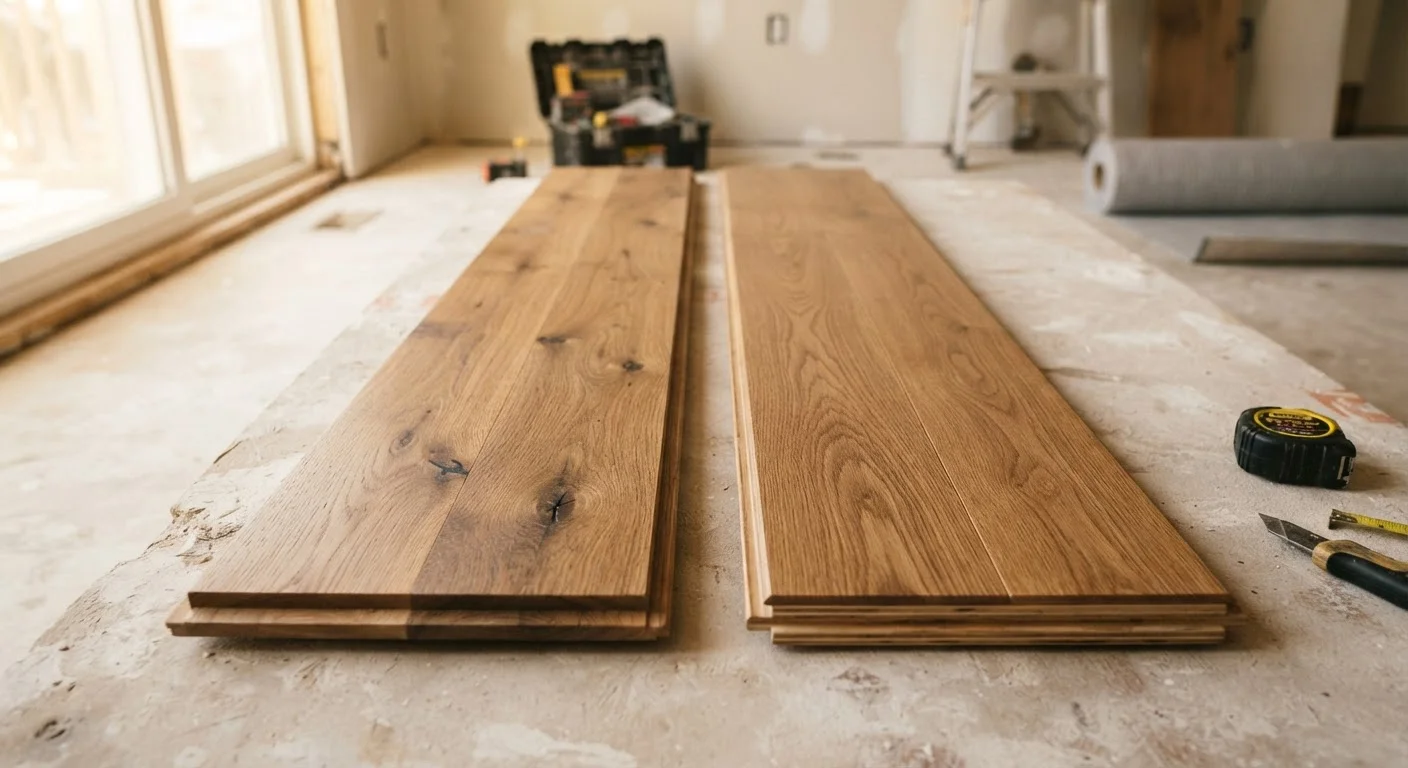
The most important distinction between these two flooring types is structural, not cosmetic. Solid hardwood is exactly what it sounds like: a plank milled from a single piece of wood, typically ¾ inch thick. Every layer you see - top, middle, bottom - is the same species. That uniformity is what allows it to be sanded flat and refinished when wear or scratches accumulate over the years.
Engineered wood flooring takes a different approach. A thin veneer of real hardwood - the species you actually see and walk on - is bonded to a core of layered wood or plywood, similar in concept to plywood itself. Those alternating grain directions in the core are engineered to counteract wood's natural tendency to expand and contract as humidity changes. The result is a product that still carries real wood on its surface but behaves more predictably in challenging conditions.
Understanding this construction difference is the foundation for every other comparison that follows.
| Criterion | Solid Hardwood | Engineered Wood |
|---|---|---|
| Construction | Single solid wood plank | Hardwood veneer over layered core |
| Typical thickness | ¾ inch standard | ⅜ to ¾ inch varies by product |
| Moisture resistance | Low - prone to expansion | Moderate - more dimensionally stable |
| Below-grade installation | Not recommended | Generally suitable |
| Over radiant heat | Generally not compatible | Often compatible - verify first |
| Refinishing potential | Multiple times (4-6+) | Limited by veneer thickness (1-3) |
| Appearance | Authentic grain, full depth | Real wood surface, similar look |
How Moisture and Installation Location Change Everything
Wood moves. It absorbs moisture from the air and expands; it releases moisture and contracts. This is normal behavior, but it creates real problems when a floor is installed somewhere that sees significant humidity swings or sits directly on a moisture-prone surface like a concrete slab.
Solid hardwood is generally not recommended for below-grade installation (basements) or directly over concrete without exceptional moisture mitigation. It is also incompatible with most radiant heat systems, which cycle through temperature and moisture conditions that cause solid planks to gap, cup, or buckle.
Engineered wood handles these conditions considerably better. Its cross-ply core limits how much the floor moves in response to environmental changes, making it a practical option for basements, over concrete with a proper moisture barrier, and above many radiant heat systems - though you should always verify compatibility with the specific product and heat system before installing.
Always Test for Moisture Before Installing
Before installing either floor type, test your subfloor for moisture - especially over concrete. Even engineered wood has moisture thresholds that, if exceeded, will void warranties and cause floor failure. Inexpensive moisture meters are widely available at hardware stores, or you can hire a flooring professional to conduct a calcium chloride or relative humidity test to get precise readings.
Before choosing either floor type, assess your subfloor: its material (wood vs. concrete), its level, and whether any moisture issues exist. Just as understanding your wall structure before a renovation prevents costly mistakes, knowing your subfloor conditions before selecting flooring prevents failures down the line.
Refinishing, Longevity, and Long-Term Value
Solid hardwood's greatest long-term advantage is its refinishability. Because the entire plank is wood, a professional can sand away surface damage and apply fresh finish - sometimes four to six times over the life of the floor. This means a well-maintained solid hardwood floor installed today could still be in service 80 years from now, which is part of why it holds strong appeal in historic homes and high-end renovations.
Engineered wood can also be refinished, but the number of times depends entirely on the veneer thickness. A veneer of 2mm or less may only tolerate one light sanding. Thicker veneers of 4mm or more allow two to three refinishing cycles. When shopping for engineered wood, veneer thickness is one of the most important specs to ask about - it directly affects long-term value.
Neither floor type is inherently superior in durability. A thin-veneered engineered floor installed in a stable environment may outlast a solid hardwood floor installed in conditions it wasn't suited for.
¾"
Standard solid hardwood plank thickness
This full thickness allows repeated sanding cycles that thinner engineered veneers cannot match.
2-6mm
Typical engineered wood veneer range
Veneer thickness is the single biggest factor in how many times an engineered floor can be refinished over its life.