
Smoke Detectors: How Many, and Where
The widely accepted standard, reflected in guidelines from the National Fire Protection Association (NFPA 72), calls for smoke alarms on every level of the home, including basements, inside each sleeping room, and outside every sleeping area. That last point surprises many homeowners - a hallway alarm outside your bedrooms is not a substitute for one inside each room.
For placement, mount alarms on the ceiling or high on a wall (within 12 inches of the ceiling). Keep them at least 10 feet from cooking appliances when possible to reduce nuisance trips. Avoid placing them near windows, doors, or ducts where airflow could interfere with detection.
Two alarm technologies exist: ionization alarms respond faster to fast-flaming fires, while photoelectric alarms respond faster to slow, smoldering fires. Many fire safety authorities recommend using both types - either as combination units or by installing both in the home.
Alarms should be tested monthly using the unit's test button, and batteries replaced at least once a year (or immediately when a low-battery chirp sounds). Hardwired alarms with battery backup follow the same battery rule. Replace the entire unit every 10 years - the sensors degrade over time even if the device still beeps when tested.
Don't overlook less-used spaces. See our guide to attics and crawl spaces for more on reaching the parts of your home that often get skipped during safety checks.
| Smoke alarm placement | Every level, inside each bedroom, outside each sleeping area (NFPA 72, National Fire Alarm and Signaling Code) |
| Smoke alarm lifespan | Replace every 10 years (NFPA recommendation) |
| CO alarm lifespan | Replace every 5-7 years (Typical manufacturer and NFPA guidance) |
| Testing frequency | Monthly for both smoke and CO alarms (NFPA 72) |
| Fire extinguisher inspection | Monthly gauge check; annual professional inspection (NFPA 10) |
| Recommended extinguisher type | Multi-purpose ABC-rated for home use (General fire safety guidance) |
Carbon Monoxide Alarms: A Different Threat, Different Rules
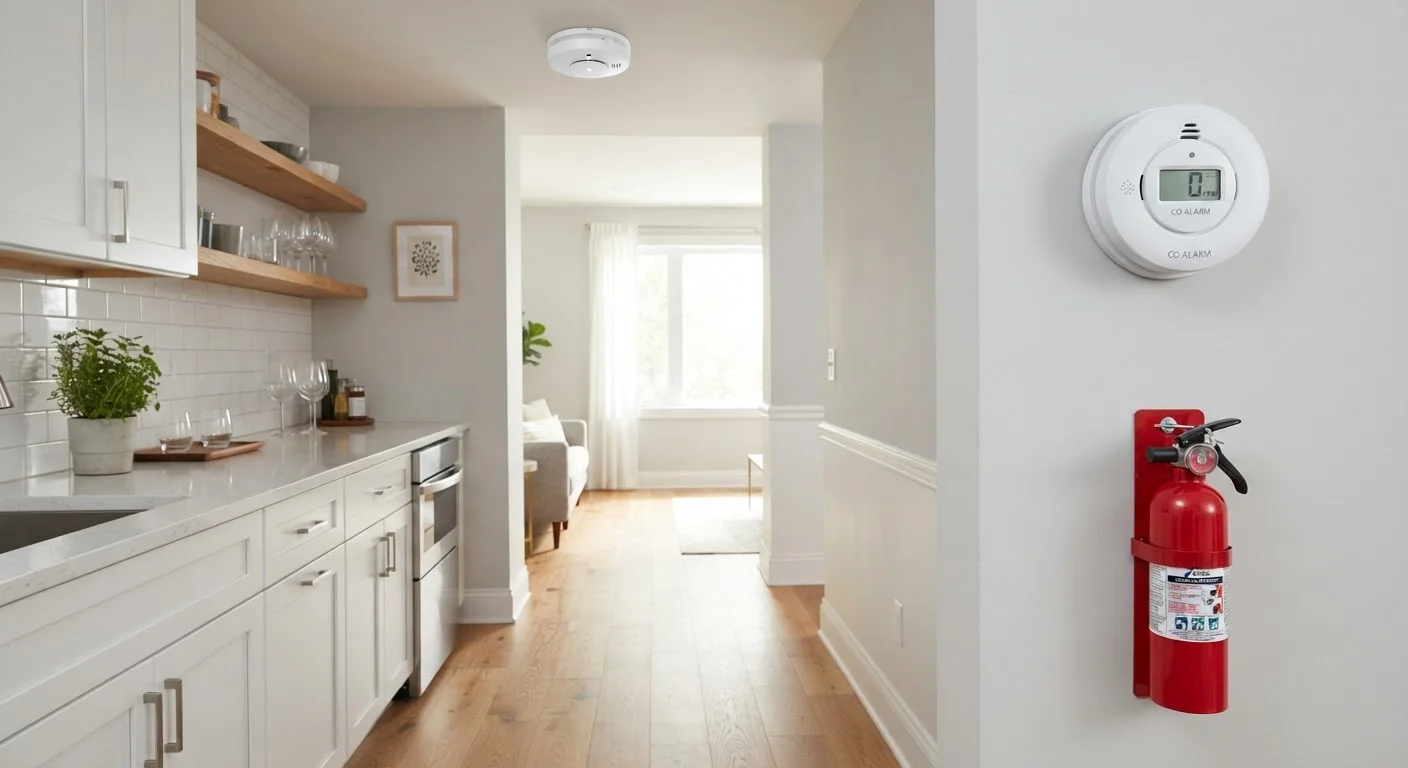
Carbon monoxide (CO) is odorless and colorless, which is why an alarm is the only reliable way to detect it. The NFPA recommends a CO alarm on every level of the home and outside each sleeping area. Many local codes now require CO alarms in any home with an attached garage or fuel-burning appliance - including furnaces, water heaters, stoves, fireplaces, and gas dryers.
Unlike smoke, CO does not rise sharply, so alarms can be mounted at any height - though manufacturer instructions may specify otherwise. Keep them away from fuel-burning appliances themselves and from areas of high humidity like bathrooms.
CO alarms have a shorter lifespan than you might expect: most units last 5 to 7 years. Check the manufacture date printed on the back of the unit and replace accordingly. Test monthly, the same as smoke alarms.
If a CO alarm sounds, do not ignore it or assume it is a false alarm. Leave immediately, leave the door open, and call 911 from outside. Never re-enter until emergency responders have cleared the home.
CO Alarm Going Off? Treat It as Real
Carbon monoxide poisoning symptoms - headache, dizziness, nausea - can easily be mistaken for illness. Never silence a CO alarm and go back to sleep. Evacuate the home immediately, get fresh air, and call 911. Emergency responders have equipment to measure CO levels and identify the source.
Pets can be affected by CO before symptoms are obvious in humans. If you share your home with animals, a properly placed CO alarm adds a layer of protection for them too. Our article on creating a safe home for pets covers other household hazards worth reviewing.
Fire Extinguishers: Placement, Type, and Limitations
Most fire safety guidance recommends at least one fire extinguisher on each floor of the home, with the kitchen being the top priority location. Mount it near an exit so you can grab it while escaping - not in a cabinet under the sink where it's hard to reach in an emergency.
For residential use, look for a multi-purpose extinguisher rated for Class A (ordinary combustibles like wood and paper), Class B (flammable liquids), and Class C (electrical) fires - often labeled ABC. A 2.5 to 5 lb unit works for most households; larger units are harder to handle under stress.
Extinguishers require annual inspection. Check the pressure gauge monthly to confirm the needle is in the green zone. Professional servicing is recommended every six years for maintained units, and most units have a recommended replacement interval of 12 years - check the label for your specific model.
Know when not to use one. A portable extinguisher is intended for small, contained fires in the early stages. If a fire has spread beyond a single object, if the room is filling with smoke, or if you are uncertain - leave immediately and call 911. Using an extinguisher should never delay evacuation. The PASS technique (Pull the pin, Aim at the base, Squeeze the handle, Sweep side to side) is the standard method taught in most fire safety training.
Ionization alarm
A smoke detector that uses a small radioactive source to detect charged particles. It responds more quickly to fast, flaming fires than to slow, smoldering ones.
Photoelectric alarm
A smoke detector that uses a light beam to sense smoke particles. It tends to respond faster to slow, smoldering fires and produces fewer cooking-related false alarms.
Carbon monoxide (CO)
A colorless, odorless gas produced by incomplete combustion of fuels. Exposure can be life-threatening, and it cannot be detected by human senses alone.
PASS technique
The standard method for using a fire extinguisher: Pull the pin, Aim at the base of the fire, Squeeze the handle, and Sweep from side to side.
Class ABC extinguisher
A multi-purpose fire extinguisher rated to handle ordinary combustibles (Class A), flammable liquids (Class B), and electrical fires (Class C). The most common type recommended for home use.