
How Each Financing Path Actually Works
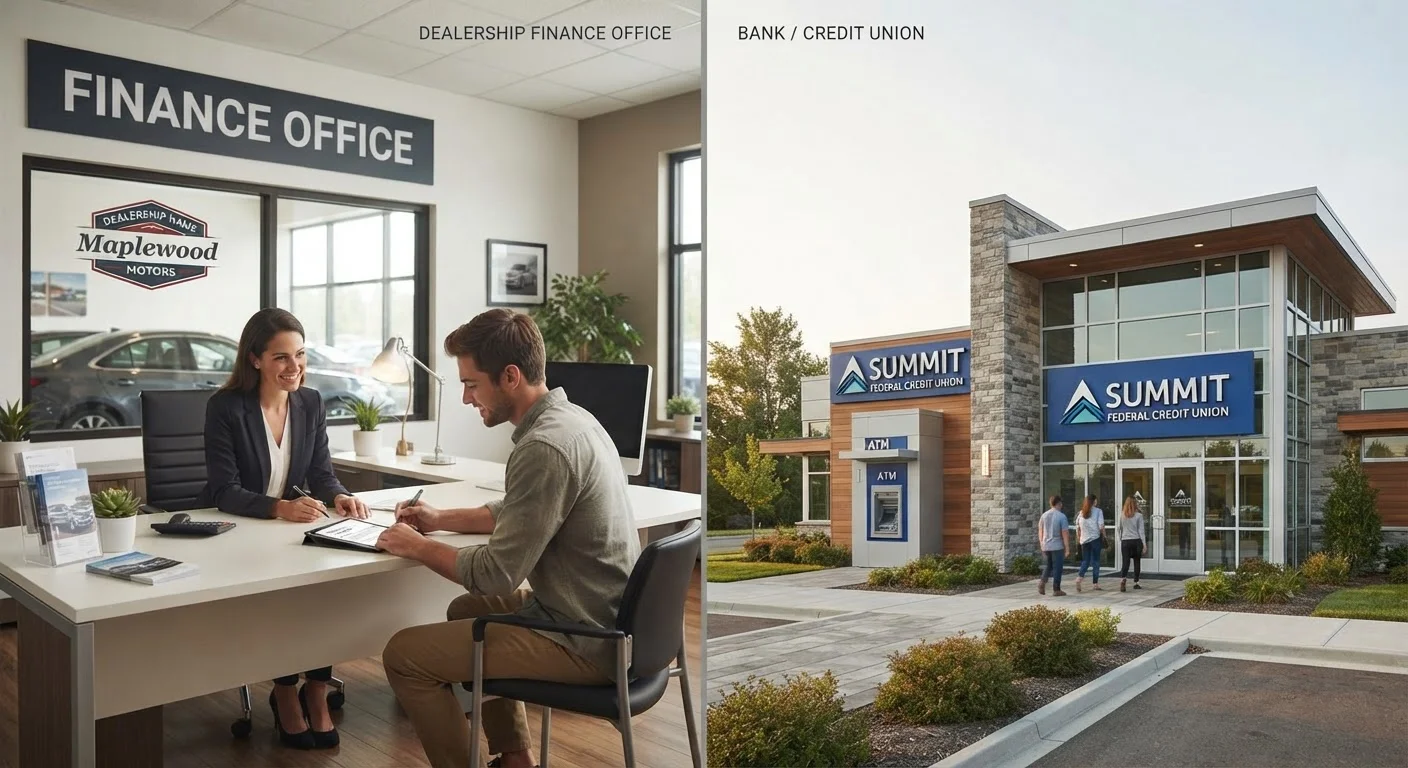
When you finance through a dealership, you're not borrowing money from the dealer itself. The dealer submits your credit application to a network of lenders - banks, captive finance companies tied to automakers, and sometimes credit unions - and then presents you with an offer. The catch: dealers are typically permitted to mark up the interest rate above what the lender actually quoted. That markup, sometimes called a dealer reserve, goes to the dealership as additional profit. The spread is often 1-2 percentage points, which can add hundreds or even thousands of dollars to the total cost of a loan over its life.
Financing through your own bank or credit union works differently. You apply directly with the institution before you shop, receive a pre-approval letter stating your maximum loan amount and interest rate, and walk into the dealership as a buyer who already has funding lined up. From the dealer's perspective, this is functionally similar to a cash buyer - which removes their leverage over the financing conversation entirely.
For a broader look at how financing fits into the overall purchase process, see the full car-buying journey walkthrough.
| Criterion | Dealer Financing | Bank / Credit Union Financing |
|---|---|---|
| Where you apply | At the dealership | Directly with lender before shopping |
| Rate transparency | Rate may include dealer markup | Rate is quoted directly to you |
| Promotional APR access | Yes, if manufacturer is offering | Not available |
| Negotiating position | Financing tied to vehicle deal | Arrive as near-cash buyer |
| Convenience | One-stop, same-day | Requires upfront application |
| Typical rate competitiveness | Varies; can be competitive or not | Often lower, especially credit unions |
| Multiple lender access | Dealer shops several lenders for you | Single institution per application |
Where Each Option Has a Clear Edge
Dealer financing wins in one specific scenario: manufacturer-subsidized promotional rates. When an automaker wants to move inventory, it sometimes offers rates well below market - 0%, 1.9%, or 2.9% APR - financed through its own captive lender. These deals are exclusive to dealer financing and cannot be matched by outside institutions. If you qualify and the math works, these offers represent genuine savings.
Outside of promotional rates, the dealer financing advantage is primarily convenience. One application, one conversation, and you drive home the same day. For buyers who aren't shopping on rate sensitivity, that frictionless experience has real appeal.
Outside financing earns its edge through transparency and control. When you arrive with a pre-approval, you already know your rate. You can negotiate the vehicle price as a separate conversation - without the monthly payment sleight of hand that sometimes obscures the true cost of a transaction. Common car-buying myths, including the idea that focusing on monthly payments is the smartest negotiating strategy, often benefit dealers more than buyers.
Rate Shopping and Your Credit Score
Many consumers worry that applying for pre-approval at multiple lenders will hurt their credit score. Credit scoring models generally treat multiple auto loan inquiries made within a short window - typically 14 to 45 days, depending on the scoring model - as a single inquiry. Comparison shopping for rates is both smart and unlikely to cause meaningful credit score damage when done within that window.
Credit unions deserve special mention. As member-owned, not-for-profit institutions, they typically return value to members through lower loan rates. Shoppers with solid credit who belong to a credit union often find it a strong first stop before any dealer conversation.
Practical Steps for Comparing Your Options
The most effective approach is to treat both paths as tools that can work together rather than mutually exclusive choices. Before visiting a dealership, apply for pre-approval at your bank or credit union. This costs you nothing and gives you a concrete benchmark. When the dealer presents a financing offer, you have a real number to compare it against.
When evaluating any loan offer - dealer or otherwise - focus on the total amount financed, the annual percentage rate (APR), the loan term in months, and the total interest paid over the life of the loan. A lower monthly payment often means a longer term, which typically means more total interest paid. The finance office at the dealership is also where add-on products get pitched; understanding what those products are and what questions to ask is a separate but important conversation. See our guide on add-ons the finance office will offer for that next step.
If the dealer can beat or match your pre-approved rate without attaching unwanted add-ons, taking the dealer offer may be perfectly reasonable. The goal is informed comparison - not reflexive loyalty to either channel. For additional questions to raise during the financing conversation, knowing what to ask your dealer can shift the dynamic meaningfully in your favor.
1-2%
Typical dealer interest rate markup range
Consumer financial education resources broadly describe dealer reserve markups of one to two percentage points above the lender's quoted rate, though the actual amount varies by lender agreement and state regulation.
~80%
New car buyers who finance through the dealership
Industry estimates have consistently shown that the large majority of new vehicle buyers use dealer-arranged financing, partly due to convenience and partly due to limited awareness of outside pre-approval options.