
The Quiet Parts That Keep Your Engine Running
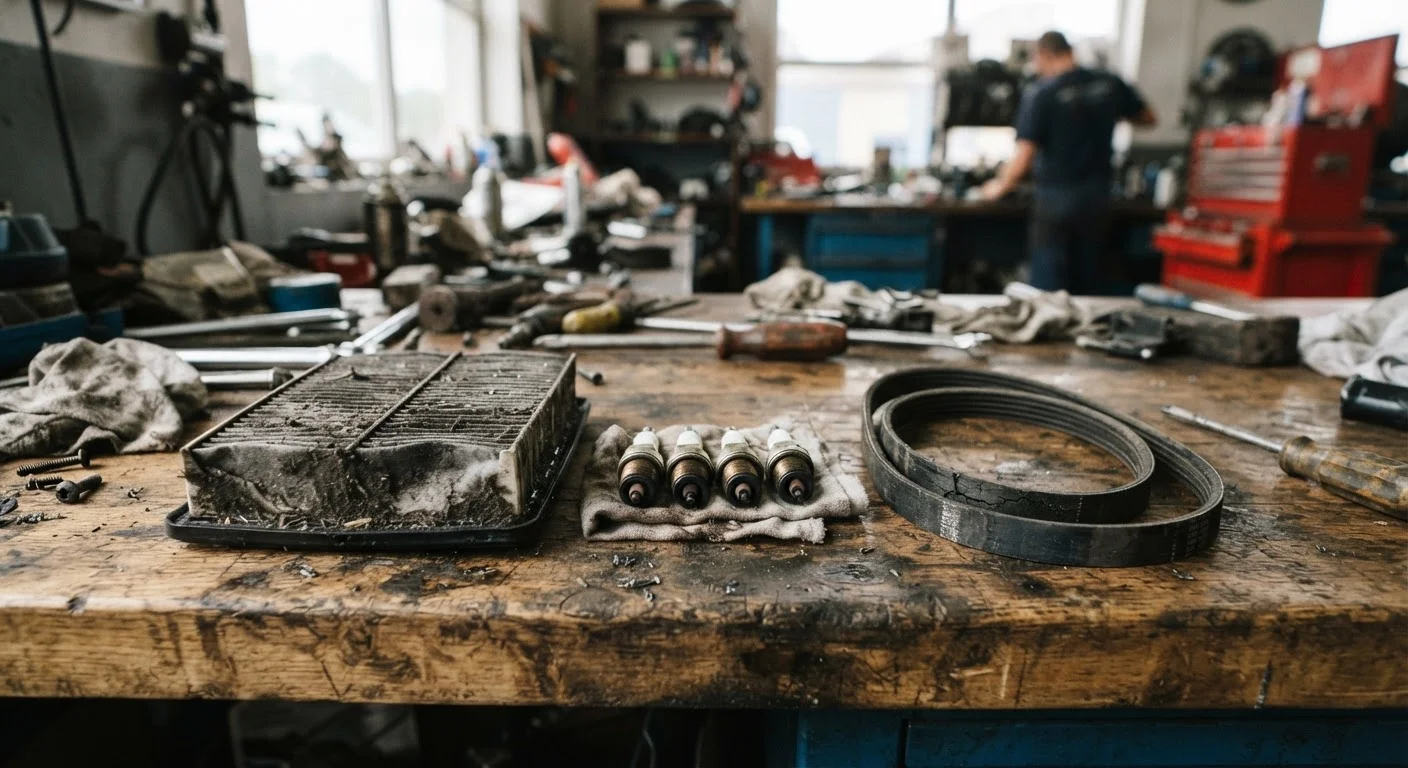
Oil changes get all the attention. Tire rotations make the checklist. But a handful of components quietly wear out in the background - air filters, spark plugs, and drive belts - and most drivers don't think about them until something goes wrong. By that point, a minor service has often become a significant repair.
These aren't exotic parts. They're inexpensive, predictably worn, and replaceable on a schedule. The challenge is that they don't trigger a dashboard warning light until they've already degraded well past their useful life. Understanding what each one does - and when it needs attention - is one of the most practical things any car owner can do. For a broader look at how these services fit into your vehicle's full upkeep timeline, see your car's maintenance schedule explained.
Engine Air Filter
The engine air filter prevents dust, debris, and contaminants from entering the combustion chamber. Every time your engine takes in air to mix with fuel, that air passes through this filter first. A clean filter allows adequate airflow; a clogged one restricts it, forcing the engine to work harder and burn more fuel to compensate.
Most manufacturers recommend replacing the engine air filter every 15,000 to 30,000 miles, though this varies depending on driving environment. Dusty or rural driving conditions shorten that interval considerably. The filter itself is typically inexpensive, and replacement is often simple enough to inspect visually - a heavily soiled filter will appear dark gray or brown rather than white or off-white.
Don't confuse the engine air filter with the cabin air filter, which cleans the air entering your passenger compartment through the HVAC system. Both need periodic replacement, but they serve entirely different purposes.
A clogged air filter forces your engine to work harder, reducing efficiency and potentially raising fuel costs.
Spark Plugs
Spark plugs ignite the air-fuel mixture inside each cylinder, triggering the controlled combustion that powers your engine. When plugs wear out, that ignition becomes inconsistent - a condition known as misfiring. Symptoms include rough idling, hesitation during acceleration, reduced fuel economy, and in more advanced cases, a check engine light tied to misfire codes.
Replacement intervals vary significantly by plug type. Copper plugs - the most basic - typically last around 30,000 miles. Iridium and platinum plugs, which are standard in most modern vehicles, can last 60,000 to 100,000 miles or more depending on the manufacturer's specification. Always follow your owner's manual rather than generic interval advice, since plug type and engine design both factor into the correct schedule.
It's worth noting that spark plug degradation is linear - performance slowly declines rather than dropping off a cliff. That makes it easy to adapt to the gradual loss without noticing it until you replace the plugs and feel the difference immediately.
Worn spark plugs degrade performance gradually - drivers often don't notice the loss until fresh plugs restore it.
Serpentine Belt
The serpentine belt is a single continuous rubber belt that drives multiple engine accessories simultaneously - typically the alternator, power steering pump, air conditioning compressor, and water pump. If this belt fails while you're driving, you can lose power steering, electrical charging, and engine cooling in rapid succession. In some configurations, it also drives the water pump, meaning a snapped belt can lead to rapid overheating.
Most serpentine belts are rated for 60,000 to 100,000 miles, but the belt should be visually inspected periodically for cracking, fraying, glazing, or missing ribs. Squealing noises from under the hood - particularly on startup or when running accessories - can indicate a worn or slipping belt. Because replacement is relatively straightforward and inexpensive, proactive replacement within the recommended window is strongly advisable rather than waiting for visible failure.
A failed serpentine belt can simultaneously knock out power steering, charging, and engine cooling.
Timing Belt (Where Applicable)
Not every engine has a timing belt - many modern vehicles use a timing chain instead - but for those that do, it's arguably the most critical belt in the system. The timing belt synchronizes the rotation of the crankshaft and camshaft, ensuring that intake and exhaust valves open and close at precisely the right moment relative to piston movement. If the timing belt breaks or skips, the result can be catastrophic internal engine damage.
Replacement intervals for timing belts typically fall between 60,000 and 105,000 miles, though this is highly model-specific. Unlike most wear items, there's often no obvious symptom before failure - the belt simply breaks. This makes adherence to the manufacturer's interval non-negotiable. When having a timing belt replaced, many mechanics recommend simultaneously replacing the water pump (if driven by the same belt), tensioners, and idler pulleys, since the labor to access them overlaps significantly.
Check your owner's manual or a trusted mechanic to confirm whether your engine uses a belt or chain - this distinction matters enormously for your maintenance planning.
Timing belt failure rarely gives warning - a broken belt can destroy an engine in an instant.
Cabin Air Filter
While the cabin air filter doesn't affect engine performance, it's among the most commonly skipped services in routine maintenance. This filter cleans the air flowing through your vehicle's heating, ventilation, and air conditioning (HVAC) system before it reaches the passenger compartment, capturing dust, pollen, mold spores, and other particulates.
A clogged cabin air filter reduces airflow through your HVAC system, which can make the blower motor work harder and diminish the effectiveness of both heating and cooling. For drivers or passengers with allergies or respiratory sensitivities, a degraded filter also means more particulate matter circulating in the cabin.
Replacement intervals are generally 15,000 to 25,000 miles or once per year, whichever comes first - though this varies by environment. The filter is typically located behind the glove box or under the dashboard and is often accessible without tools, making it one of the easier DIY maintenance tasks for drivers comfortable with basic vehicle upkeep.
A clogged cabin air filter quietly reduces HVAC efficiency and the quality of air inside your vehicle.
Don't Wait for a Warning Light
Each of the components covered here shares a common trait: failure is gradual, not sudden. A clogged filter doesn't instantly kill your engine. A worn plug doesn't immediately stall your car. A fraying belt doesn't snap on the first mile. That slow degradation is exactly what makes them easy to defer - and exactly why deferred maintenance tends to compound. Skipping routine maintenance costs more than you think, and these three items are textbook examples of small neglect becoming large expense.
Track Mileage at Every Service
Log the odometer reading each time you replace a filter, plug, or belt - not just when you get an oil change. Many drivers rely on memory or assume the shop tracked it, only to find no record exists. A simple mileage log removes all guesswork and makes it easy to stay on schedule across multiple components with different replacement intervals.
Keep a simple log - even a notes app on your phone - recording the mileage at each service. When you know your spark plugs went in at 68,000 miles, there's no guesswork at 100,000. It also helps a mechanic understand your car's history at a glance. For first-time owners building these habits from scratch, building a car maintenance routine is a practical starting point.