
Why Tire Care Matters
Tires are the only part of your vehicle that actually touches the road. That single fact makes them one of the most safety-critical components you maintain - yet tire care is frequently overlooked until something goes obviously wrong. Underinflated, worn, or unevenly loaded tires reduce braking performance, degrade handling, increase blowout risk, and quietly drain your fuel economy over time.
The good news is that routine tire maintenance requires no special mechanical skill. A pressure gauge, a penny, and a basic understanding of when to schedule a rotation are all most drivers need. This guide covers those three foundations. For a broader view of where tires fit into your overall vehicle upkeep, see building a car maintenance routine from day one.
Tire Pressure: The Right Number and How to Check It
Tire pressure is measured in PSI. The correct PSI for your vehicle is set by the manufacturer based on the vehicle's weight, suspension geometry, and handling targets - not by the tire maker. You'll find it on a sticker inside the driver's door jamb, and sometimes in the owner's manual. Ignore the number on the tire sidewall for inflation purposes; that figure is the maximum pressure the tire can structurally hold, not your target.
Check Pressure When Tires Are Cold
Always measure tire pressure before driving or after the car has sat for at least three hours. Driving heats the air inside and raises the reading, which can cause you to underinflate a tire that's actually low. A brief morning check before your first trip of the day gives you the most accurate number.
Check pressure when tires are cold - meaning the car has been parked for at least three hours or driven fewer than a mile at low speed. Driving heats the air inside tires and raises pressure artificially, giving you a misleadingly high reading.
Temperature swings matter too. A drop of 10°F causes tire pressure to fall roughly 1 PSI. Seasonal transitions - especially the shift from fall to winter - are common times for drivers to notice their tire pressure warning light illuminate.
PSI
Pounds per square inch - the unit used to measure how much air pressure is inside a tire. Your vehicle has a specific target PSI listed on the driver's door jamb sticker.
Tread depth
The measurement from the top of the tire's rubber grooves down to the bottom channel. More depth means better water evacuation and grip; less depth signals a worn tire.
Cold pressure
Tire pressure measured when the car hasn't been driven recently, so heat from driving hasn't artificially increased the air pressure inside. Always check pressure when tires are cold for an accurate reading.
Valve stem
The small rubber or metal stem protruding from each wheel rim, covered by a small cap. Pressing a pressure gauge onto it lets you measure the air pressure inside the tire.
Tire rotation
The practice of moving tires from one wheel position to another - front to rear, side to side, or diagonally - to distribute wear evenly across all four tires.
Directional tires
Tires designed with a tread pattern that works correctly only when rotating in one specific direction. They can only be moved front-to-rear on the same side of the vehicle during rotation.
To check pressure, remove the valve cap on the tire, press a tire pressure gauge firmly onto the valve stem, and read the result. Digital gauges are easy to read; stick gauges are inexpensive and reliable. Top off with air at a gas station if needed, and don't forget to check the spare.
Tread Depth: Knowing When Tires Are Worn Out
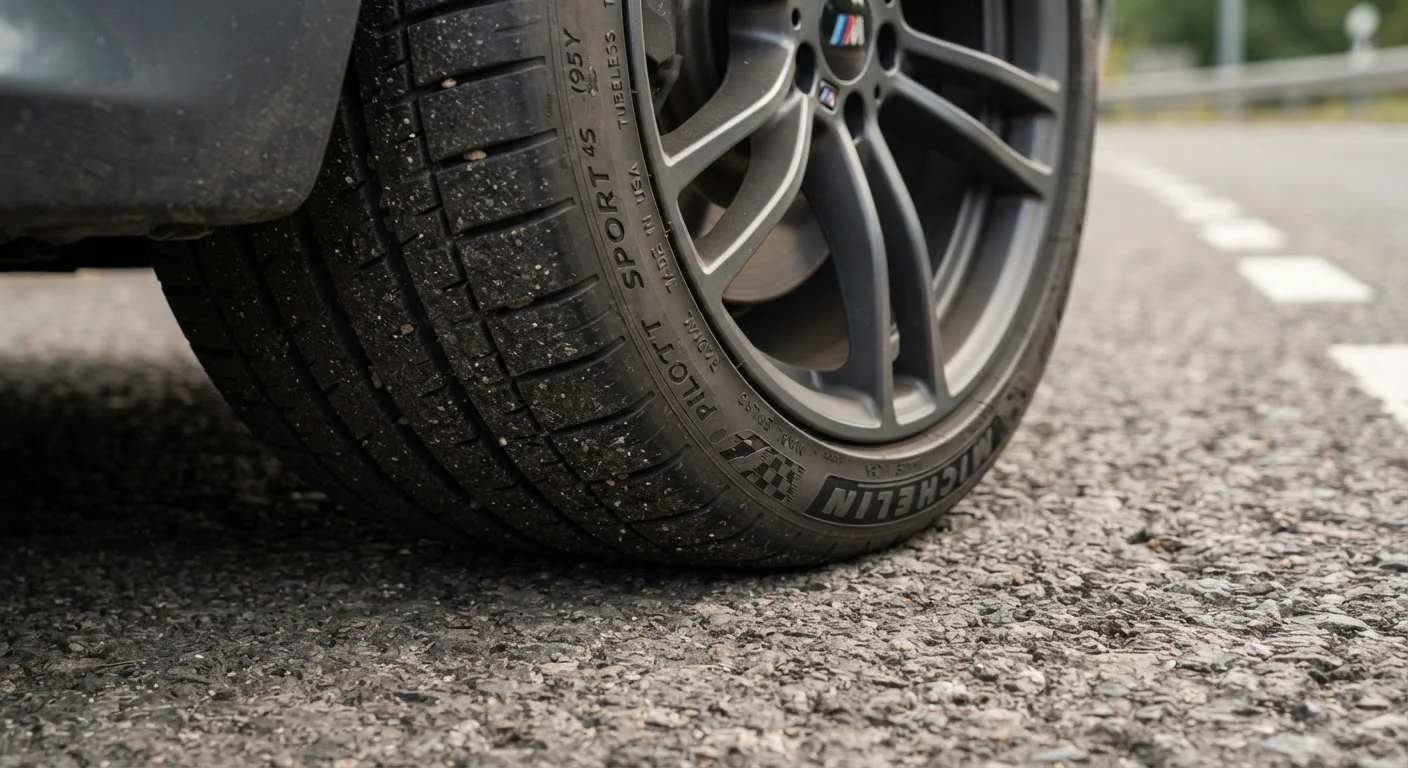
Tire tread channels water away from the contact patch between tire and road. As tread wears down, wet-weather grip degrades and stopping distances increase. In most U.S. states, tires are legally required to have at least 2/32 inch of tread remaining - but many safety experts recommend replacing tires before reaching that limit, around the 4/32-inch mark, especially if you drive in rain or snow.
The penny test is the most widely known quick check: insert a penny into the tread groove with Abraham Lincoln's head pointing down. If Lincoln's head is completely visible, you're at or below 2/32 inch and the tire needs replacement. Substitute a quarter for an earlier warning - Washington's head disappearing into the tread indicates you still have approximately 4/32 inch.
Also look for uneven wear patterns. Wear concentrated at the center of the tread suggests chronic overinflation. Wear along both outer edges points to underinflation. Wear on only one edge often signals an alignment problem. Any of these patterns warrants a conversation with a qualified mechanic, since alignment and suspension issues affect tires faster than normal driving would. You can learn more about how related systems interact in our overview of how your braking system works.
Tire Rotation: Why It Extends Tire Life
Tires don't wear evenly on their own. Front tires on a front-wheel-drive vehicle handle steering, braking, and the majority of acceleration forces - so they wear faster than the rears. Even on rear-wheel-drive and all-wheel-drive vehicles, weight distribution and cornering loads create uneven wear across all four tires. Rotation moves each tire to a different position at regular intervals, spreading that wear more evenly across all four tires.
A common interval recommendation is every 5,000 to 7,500 miles, though your owner's manual may specify differently. Many drivers coordinate rotation with oil changes as a convenient reminder. The specific rotation pattern - straight swap, X-pattern, or rearward cross - depends on whether your tires are directional (designed to roll only one way) or non-directional, and whether all four tires are the same size.
Rotation is a straightforward shop service that typically takes under an hour. While it's technically possible to do at home with proper equipment, incorrectly torqued lug nuts pose a serious safety hazard, so most drivers are best served by having a qualified technician handle it. Keeping rotation on a consistent schedule is a practical habit worth building into your broader maintenance calendar - see building a maintenance schedule you can stick to for a structured approach.