
Why Most Maintenance Schedules Fall Apart
The majority of car owners know maintenance matters - they just struggle to track it consistently. Relying on memory alone, waiting for a warning light, or only servicing the car when something feels wrong are patterns that lead to skipped intervals and avoidable repair bills. The solution isn't discipline; it's structure.
A functional maintenance schedule works on two axes: mileage and time. Mileage-based intervals suit high-mileage drivers well, but a vehicle driven only 5,000 miles per year still needs fluid changes - oil degrades with age, not just use. That's why manufacturer schedules almost always specify both. Understanding what each service milestone actually means is the first step toward building a schedule that makes sense for your specific vehicle and driving habits.
It's also worth separating fact from manufacturer and shop recommendations. Some service intervals have been extended significantly as vehicles and lubricants have improved. Common maintenance myths - like the blanket 3,000-mile oil change rule - can lead to unnecessary spending if you follow them uncritically rather than consulting your owner's manual.
Always Start With Your Owner's Manual
Factory-recommended intervals in your owner's manual are specific to your engine, transmission, and drivetrain - not generic averages. Third-party interval suggestions and shop recommendations sometimes diverge from manufacturer guidance. When in doubt, the manual is authoritative.
What You Need Before You Start
Building an accurate schedule takes about 20-45 minutes the first time. Gather the following before you begin:
What you will need
If your vehicle is used and you don't have complete records, don't guess - a qualified mechanic can inspect key wear items and give you a realistic picture of what's been done and what's overdue. For vehicles approaching or past 100,000 miles, a targeted high-mileage maintenance review can help identify which systems need the most attention going forward.
Owner's Manual
Provides the manufacturer-specified maintenance intervals for every fluid, filter, and inspection on your vehicle.
Spreadsheet or Maintenance App
Organizes service tasks by mileage and date, and stores records of completed work.
Mileage Log or Odometer Photo
Gives you an accurate starting point so interval calculations are correct from day one.
Calendar or Phone Reminder App
Triggers time-based service alerts for tasks like battery checks and seasonal inspections.
Building Your Schedule Step by Step
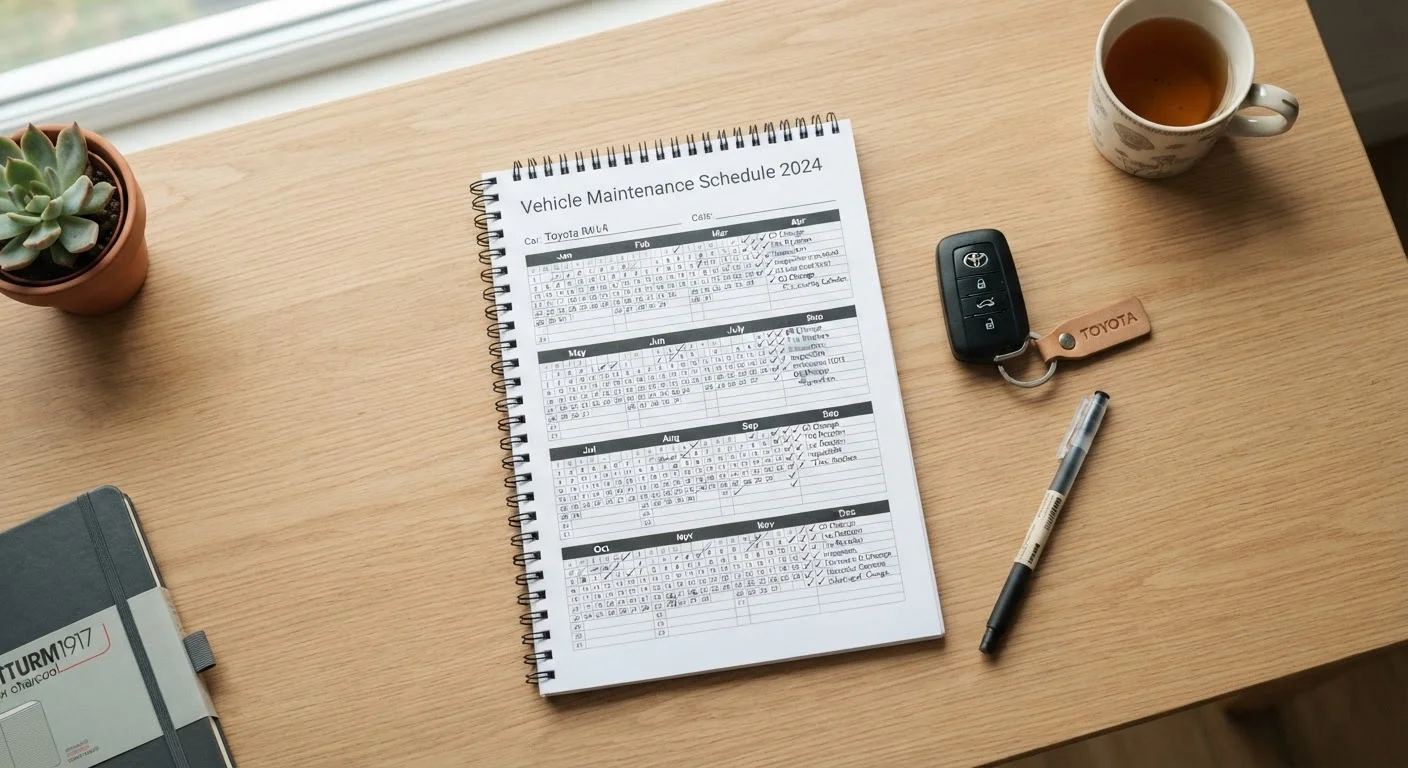
Follow these steps to create a maintenance schedule organized by your vehicle's actual intervals - not generic averages.
Pull Your Owner's Manual and Record Your Current Mileage
Open your owner's manual to the maintenance schedule section - often labeled "Scheduled Maintenance" or "Maintenance Intervals." Note the two schedules most manuals include: a normal schedule and a severe-duty schedule. Write down your current odometer reading and today's date. This is your baseline.
List Every Service Task and Its Interval
Go through the maintenance schedule and write out every task the manufacturer specifies - oil and filter changes, tire rotations, air filter replacement, cabin air filter, brake fluid, coolant flush, spark plugs, transmission fluid, drive belts, and any model-specific items. Record each task's interval in both miles and months, since many services have dual triggers (e.g., every 7,500 miles or 12 months, whichever comes first).
Group tasks by interval category to simplify the schedule:
- Every 5,000-10,000 miles: Oil change, tire rotation, visual brake inspection
- Every 15,000-30,000 miles: Air filters, battery test, wiper blades
- Every 30,000-60,000 miles: Brake fluid, transmission fluid, spark plugs (on many vehicles), coolant
- Every 60,000-100,000+ miles: Drive belts, timing belt (if applicable), fuel system components
Calculate When Each Service Is Due
Using your current mileage and any past service records, calculate the next due mileage for each task. If you have no service history - common with used vehicles - consult a qualified mechanic about what to inspect or service as a reset baseline. For time-based triggers, count forward from today or from the last known service date.
Enter each item into your spreadsheet or app with two columns: Next Due (Miles) and Next Due (Date). Update these after every service visit.
Set Reminders Before the Due Date, Not On It
Build in a buffer of roughly 500 miles or 2-3 weeks before each due date. This gives you time to schedule an appointment, source parts if you do your own maintenance, and avoid accidentally rolling past the interval. Use your phone's calendar, a dedicated app, or a simple note in your vehicle to flag the upcoming service.
Log Every Service Completed
After each service - whether done by a shop or yourself - record the date, mileage, what was done, and who performed it. Keep receipts when possible. A complete service log supports your vehicle's resale value, demonstrates to future buyers that the car was maintained, and helps you and any mechanic spot patterns in wear or recurring issues. Vehicles with high mileage especially benefit from thorough documentation, as it helps a mechanic prioritize what to inspect next.
Review and Adjust the Schedule Annually
Once a year, review your schedule against your actual driving patterns. If you drove significantly more or less than anticipated, recalculate upcoming intervals accordingly. If your driving conditions have changed - new commute, more highway miles, seasonal towing - reassess whether the normal or severe-duty schedule applies. A schedule that reflects how you actually drive is far more useful than a generic one.
Severe Driving Conditions Change the Math
Frequent short trips under 5 miles, stop-and-go city driving, dusty environments, towing, and extreme temperatures all qualify as "severe" use by most manufacturer definitions. If your driving fits this profile, many services - including oil changes and transmission fluid checks - should be done more frequently than the standard interval. Check the severe-duty schedule in your owner's manual, which is usually a separate section from the normal schedule.
Use Reminders That Match How You Think
Some drivers track mileage naturally; others lose track between oil changes. If you think in months rather than miles, set calendar reminders for every service. If you drive a predictable commute, mileage-based alerts in your phone or a simple sticky note on your dashboard work well. The best system is the one you'll actually use.
Adapting Your Schedule for Seasonal Changes
Some maintenance tasks are less about mileage and more about the calendar. Battery performance drops significantly in cold weather; tires lose pressure as temperatures fall; wiper blades and washer fluid become critical in winter months. A complete schedule accounts for these seasonal checkpoints alongside the standard mileage-based services.
Seasonal vehicle preparation is a practical complement to a mileage-based schedule - it layers in climate-related checks that don't fit neatly into an interval chart but matter just as much for reliability and safety. Reviewing your schedule at the start of each season takes only a few minutes and can prevent cold-weather surprises.
If you're new to tracking vehicle upkeep systematically, a first-time owner's maintenance routine offers a complementary foundation covering the recurring habits and basic checks that experienced owners do almost automatically.