
How to Read Pest Damage Like a Detective
Most gardeners spot the damage long before they ever see the culprit. A ragged hole in a leaf, a wilting stem with no obvious cause, or a sticky residue on your tomatoes - each clue points to a specific pest with a specific feeding strategy. Learning to read these patterns saves time, reduces guesswork, and helps you respond without reaching for the wrong remedy.
Pest damage generally falls into a few broad categories: chewing damage (irregular holes, missing leaf margins), piercing-sucking damage (stippled or yellowing leaves, distorted growth), boring damage (tunnels inside stems or fruit), and root feeding (wilting plants with healthy-looking tops). Knowing which category you're dealing with narrows your suspect list immediately.
Frass
The waste material - essentially excrement and plant debris - left behind by feeding insect larvae. It often looks like sawdust or fine granules and is a key diagnostic sign near boring pests.
Honeydew
A sweet, sticky liquid excreted by sap-sucking insects like aphids and whiteflies. Its presence often signals an active infestation and can promote the growth of sooty mold on leaves.
Skeletonizing
A type of feeding damage where insects eat the soft leaf tissue between the veins, leaving behind a skeletal, lacy structure. Japanese beetles are a common cause.
Stippling
A pattern of tiny pale or silvery dots on leaf surfaces caused by piercing-sucking insects or mites that puncture individual plant cells. It is a hallmark sign of spider mite activity.
Overwintering
The process by which insects survive winter - as eggs, pupae, larvae, or adults - often sheltering in soil, leaf litter, or bark. Disrupting these sites in fall can reduce pest pressure the following season.
The Most Common Culprits and Their Signatures
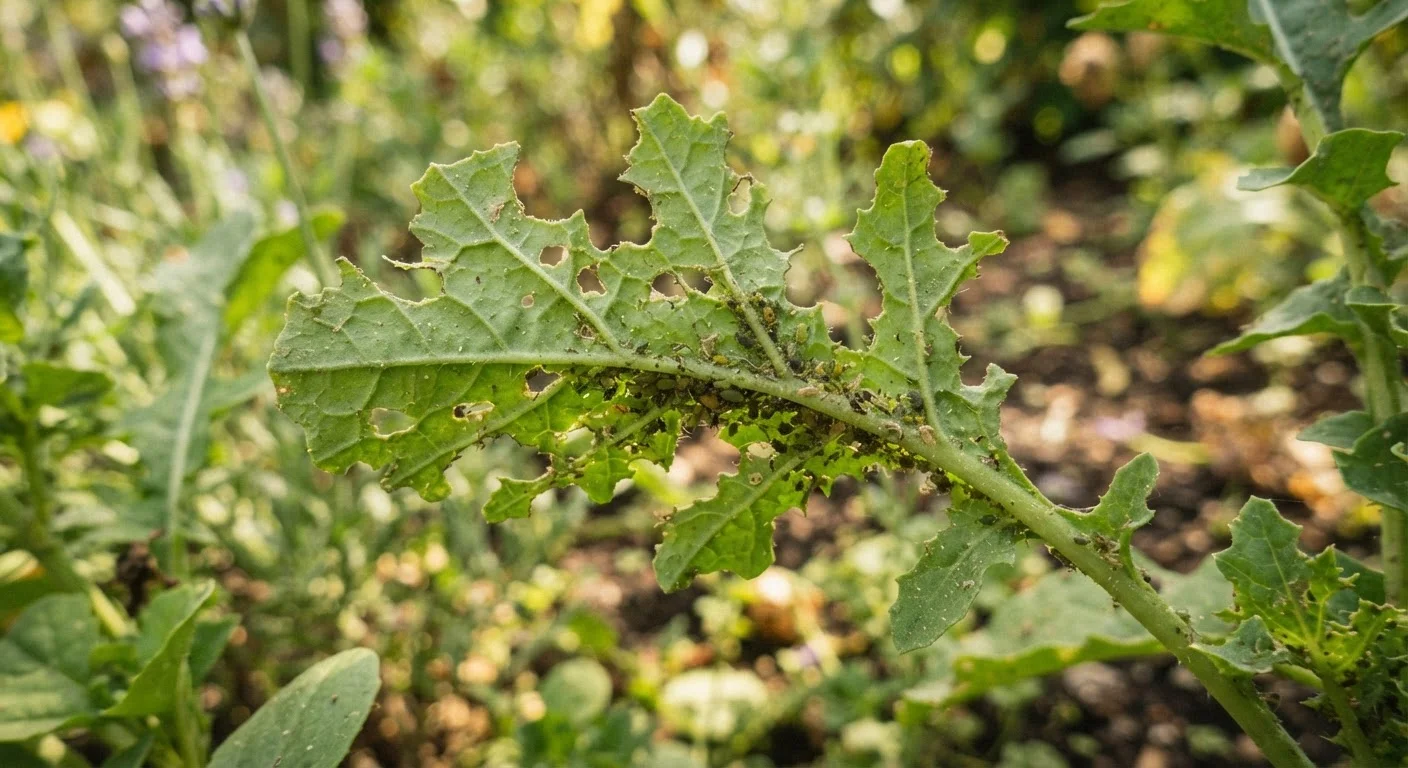
Aphids are tiny, soft-bodied insects that cluster on new growth and the undersides of leaves. They pierce plant tissue and suck sap, causing leaves to curl, pucker, or yellow. A telltale sign is honeydew - a sticky, shiny residue that aphids excrete - which often leads to sooty mold. Aphids reproduce rapidly, with some species producing multiple generations in a single season without mating.
Japanese beetles skeletonize leaves by eating the tissue between veins, leaving a lacy, papery appearance. Adults feed on over 300 plant species. Their grubs, meanwhile, live underground and chew grass and plant roots, causing dead patches in lawns that lift like loose carpet.
Cutworms are moth larvae that feed at or just below the soil surface, severing seedling stems at ground level overnight. Finding a healthy seedling lying flat with a cleanly cut base is the signature sign. They curl into a C-shape when disturbed and tend to attack in spring when soil temperatures warm.
Spider mites are not true insects but arachnids - and nearly invisible to the naked eye. They cause stippling (tiny pale dots) on leaves by piercing cells. In dry, hot conditions, populations can explode within days. Fine webbing on leaf undersides confirms their presence.
Squash vine borers enter stems near the base, hollowing them out from within. Wilting of an otherwise healthy-looking squash plant - combined with a small entry hole and sawdust-like frass - signals their activity. By the time wilting appears, the larva has often been feeding for days.
| Aphid reproduction speed | Up to 80 offspring per week per female (University Extension entomology resources) |
| Japanese beetle host plants | Over 300 species (USDA Animal and Plant Health Inspection Service) |
| Spider mite generation time | As few as 5-7 days in hot, dry weather (Cooperative Extension entomology programs) |
| Cutworm feeding window | Primarily at night, at or below soil surface (General entomological observation) |
| Squash vine borer detection challenge | Larvae feed inside stems; external wilting appears late (Land-grant university vegetable pest guides) |
Life Cycles Matter - Here's Why
Effective pest management depends on timing, and timing depends on understanding life cycles. Many pests are only vulnerable during specific life stages. Japanese beetle grubs, for example, are most susceptible to intervention in late summer when they are small and close to the soil surface - not in spring when they are larger and deeper. Similarly, targeting aphids before populations peak prevents the population explosion that makes control difficult.
Monitoring your garden consistently - rather than only when damage appears - gives you the lead time to act early. Simple practices like turning over leaves weekly, inspecting stems at soil level, and watching for early yellowing can reveal pest activity before it escalates.
Understanding that many pests overwinter as eggs, pupae, or adults in garden debris and soil also points toward a practical prevention strategy: clearing spent plant material in fall and cultivating the soil disrupts overwintering sites without any chemical inputs. Pairing these habits with companion planting strategies that naturally deter specific pests adds another layer of protection.
Healthy soil also plays a role - plants growing in well-structured, nutrient-appropriate soil tend to be more resilient. If you haven't assessed your garden's foundation recently, our guide to soil amendments explains how to identify and address deficiencies that may be leaving your plants more vulnerable to pest stress.