

Why Soil Quality Matters More Than Most Gardeners Realize
You can plant the right variety in the right sunlight and still watch it struggle if the soil underneath is working against you. Compacted clay drowns roots. Sandy soil lets water and nutrients drain away before plants can use them. Soil that is too acidic or too alkaline locks out nutrients that are technically present - the plant simply cannot access them.
Soil amendments are the tools gardeners use to fix these underlying conditions. Before reaching for them, though, it is worth understanding what your soil actually lacks. Guessing can backfire. Adding lime to soil that is already too alkaline, for example, only makes the problem worse. If you are starting a new garden from scratch, a soil test before planting is one of the highest-value steps you can take.
70%
U.S. soils with less than ideal organic matter
Soil scientists commonly note that the majority of cultivated American soils have seen organic matter decline significantly from historical levels due to tillage and development.
6.0-7.0
Optimal pH range for most vegetables
Most university extension guidelines recommend this pH range for vegetable gardens, as it keeps the widest range of nutrients soluble and accessible to plant roots.
2-6 months
Time for lime to meaningfully shift soil pH
Cooperative extension soil management resources consistently note that pH-adjusting amendments require significant lead time before planting to be effective.
Organic Amendments: Building Soil From the Ground Up
Organic amendments are derived from living or once-living material. They decompose over time, feeding soil microbes and gradually improving structure. These are the workhorses of long-term soil health.
- Compost: Decomposed plant and food matter that improves drainage in clay soils, water retention in sandy soils, and feeds soil biology across the board. It is the most broadly useful amendment for almost any garden. See our guide to setting up a home composting system if you want to make your own.
- Aged manure: Adds nitrogen and organic matter, but must be well-composted before use on food gardens to reduce pathogen risk.
- Peat moss: Improves water retention and lowers pH slightly - useful for acid-loving plants, though its environmental sourcing is a consideration worth noting.
- Coconut coir: A byproduct of coconut processing with similar water-retention benefits to peat moss and a more renewable sourcing profile.
- Wood chips and leaf mold: Excellent for mulching and gradual organic matter addition, though they break down slowly and can temporarily tie up nitrogen as they decompose.
Organic amendments generally improve soil over a full growing season or longer - they reward patience and consistent application.
Start with Compost Before Anything Else
If you are unsure where to start, compost is the most forgiving and broadly beneficial amendment for nearly any soil type. It rarely causes harm in reasonable quantities and improves conditions whether your soil is too dense, too loose, or simply low in organic matter. Once you have a soil test in hand, you can layer in more targeted amendments from there.
Inorganic Amendments: Targeted Fixes for Specific Problems
Inorganic amendments do not decompose, but they solve specific structural or chemical problems quickly and reliably.
- Perlite: Volcanic glass expanded by heat into lightweight, porous granules. Mixed into dense soil, it creates air pockets that improve drainage and root penetration. Common in container mixes and raised beds.
- Vermiculite: A heat-expanded mineral that retains moisture and nutrients while also improving aeration - well-suited for seed-starting mixes or sandy soils that drain too fast.
- Sand (coarse): Can improve drainage in clay soils, but only when added in very large quantities - typically at least 50% by volume. Adding small amounts of sand to clay actually worsens compaction.
- Agricultural lime (ground limestone): Raises soil pH in acidic soils, making nutrients more available to most vegetables and lawn grasses. Works slowly - plan months ahead.
- Sulfur: Lowers pH in alkaline soils. Useful when growing blueberries, azaleas, or other acid-preferring plants. Also works gradually.
- Gypsum: Adds calcium and sulfur without changing pH - particularly helpful for breaking up compacted clay or reclaiming soil affected by road salt or sodium buildup.
More Amendment Is Not Always Better
A common mistake is over-applying amendments - especially lime, sulfur, or high-nitrogen manures - without retesting soil afterward. Soil chemistry can shift past the target range just as easily in the wrong direction. Always follow soil test recommendations for quantities, and retest after a full growing season before applying again.
Reading Your Soil: When to Amend and When to Leave Well Enough Alone
Healthy soil that produces thriving plants does not need intervention. The goal of amending is always to correct a specific deficiency or imbalance - not to follow a general routine of adding things.
Signs your soil may benefit from amendment include: poor drainage after rain, a hard surface crust that prevents water absorption, stunted plant growth despite adequate watering and sun, yellow or discolored leaves suggesting nutrient lockout, and plants repeatedly underperforming despite correct care.
A basic pH test from a garden center costs just a few dollars and tells you a great deal. A more comprehensive soil test - available through many state university extension programs - reveals organic matter percentage, nutrient levels, and textural information that guides amendment choices precisely.
If you are weighing whether to build raised beds with imported soil mix versus amending your native soil, our comparison of raised beds versus in-ground planting walks through the trade-offs in detail. For in-ground beds, pairing amendments with a good mulching practice helps maintain soil moisture and temperature while amendments work beneath the surface.
A homeowner notices their vegetable garden drains so poorly that plants sit in standing water after rain. A soil test confirms heavy clay content.
A gardener's blueberry bushes produce poorly despite regular watering. A soil test shows pH of 6.8 - too alkaline for blueberries, which prefer 4.5-5.5.
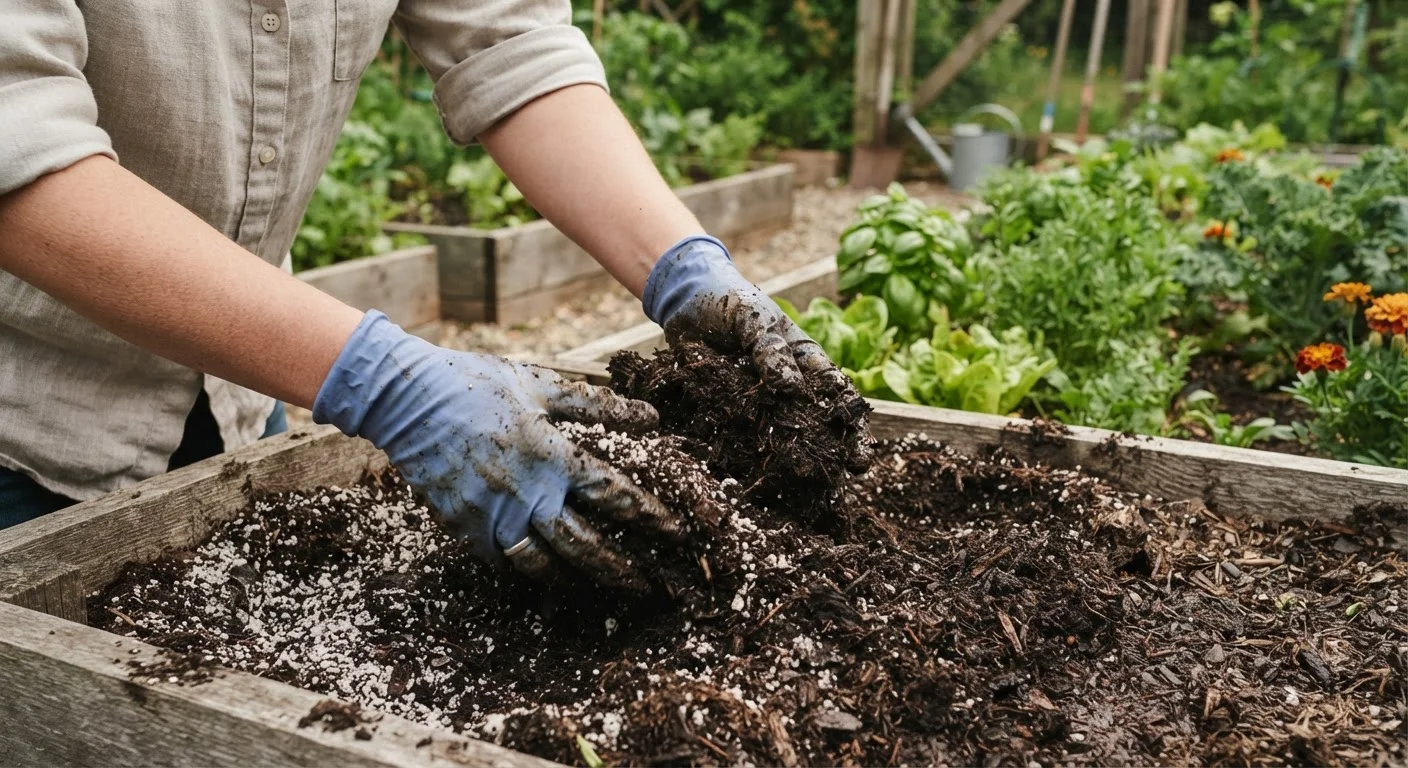
A first-time vegetable gardener adds bagged compost and perlite to a raised bed filled with native soil.
A lawn in the Northeast shows yellow patches and thin turf. A soil test reveals very acidic soil with a pH of 5.0.